Egyptian Tomb, 1922
Carter's dig as a dinner party, built from his own journal, a 1923 Library of Congress photograph and the Met's Egyptian collection: a sealed paper doorway guests break at 7:30, an LED candle for the first look, ful medames and a fig-and-date board, object tags for everyone, and a curse quiz the BMJ already settled.
Decor Checklist
- Kraft paper, painter's tape and a black marker Essential
The sealed doorway: paper taped across one door frame, with round seal marks drawn on it, for guests to break at 7:30
- Ollcuz Rechargeable LED Flame Lights (2) Essential
Carter's candle, without the flame: one behind the paper doorway, one carried in for the first look
Shop on Amazon → - Natural Burlap Fabric, 40 in x 15 ft Essential
Sand-coloured cloth over tables and chairs in the antechamber, instead of loose sand
Shop on Amazon → - Hiceeden Brass Handheld Magnifier Nice to have
For the dig table, where the registrar checks each find before it gets a tag
Shop on Amazon → - Printed Met object cards, a notebook and twine Essential
The finds for the registration game, and the register they go into
- A closed chest or cooler Optional
The only 'coffin' in the house. It stays shut. If its ice goes into drinks, use a food-safe cooler, not a prop
Menu
Playlist
Listen on Hallowmix →
Costumes
Host
- The excavator: khaki shirt and trousers, a notebook in the pocket and an LED flame light in hand
- The expedition photographer, with a box camera or any old camera on a strap
Guests
- A 1923 evening dress or suit, with Tut-craze jewellery from the party circuit
- The financier in tweeds, checking the accounts
- The reporter who wants the story first
- The conservator in an apron, with a soft brush
- The film Mummy, wrapped over dark clothes
Party Timeline
- 5:00 PM: Barley salad done, tea chilling, dukkah in its jar since last week. Paper doorway taped up.
- 7:00 PM: The step. Guests arrive at the top of the stairs or the front path, and get their object tags.
- 7:30 PM: Seals intact. Everyone gathers at the paper door; the host makes a small hole and looks through with the LED light.
- 8:00 PM: Supper in the antechamber.
- 9:00 PM: The registration game. Hidden object cards, found and tagged.
- 10:00 PM: Curse or Mosquito? The quiz.
- 11:00 PM: 'Old King Tut' on the speakers, and dancing.
Shopping List
- Invitations and object tag place cards (free printables), 110 lb cardstock, A7 kraft envelopes, a 1/4-inch hole punch, twine
- Brown kraft paper, painter's tape, a thick black marker
- Two LED flame lights, burlap, a brass magnifier, a notebook
- Fava beans (four 15-oz cans), garlic, olive oil, cumin, tahini, lemons, tomatoes, onion, parsley, eggs (optional)
- Canned chickpeas, shelled pistachios, sesame seeds, coriander, cumin and fennel seeds, pita
- Pearl barley, pomegranate molasses, cinnamon, golden raisins, cilantro, feta, scallions, pomegranate seeds
- Fresh or dried figs, dates, pomegranates, a round loaf
- Dried hibiscus flowers (4 1/2 oz for three batches), oranges, lemons, ginger, cinnamon sticks, star anise, cloves, cane syrup, dark rum, mint
- Beer
The Premise
It’s November 1922, and the seals on the door are still intact. Guests arrive as the people at the dig and on the edges of it: the excavator, the photographer, the conservator, the financier, the reporter, a couple of officials and a few friends of the expedition dressed for a 1923 dinner. At 7:30 the host breaks a small hole in a paper door and looks through with a light, and the evening runs from there.
The history on this page comes from Howard Carter’s own journal, the Library of Congress, the Metropolitan Museum of Art, JSTOR Daily and Smithsonian, museum and university pages, and a peer-reviewed study of the “curse”; the recipes are America’s Test Kitchen’s. It’s a party about the dig, not a costume party about Egypt: nobody comes as “an Egyptian,” the only coffin in the house stays shut, and the section on dressing the part explains why.
It’s a party for twelve. The invitation is a field telegram quoting Carter’s cable, and the place cards are object registration tags, one role each.
The Real Dig
The step and the cable
Carter’s pocket diary for Saturday, November 4, 1922 says only “First steps of tomb found.” His longer excavation journal for the same day begins: “At about 10am I discovered beneath almost the first hut attacked the first traces of the entrance of the tomb” (Griffith Institute, Carter’s diary and journal). The Griffith Institute in Oxford holds his notebooks and publishes the transcription.
The next evening, with the staircase cleared down to a blocked doorway, he filled it back in and “cabled to Ld. C. (then in England).” JSTOR Daily gives the cable as “At last have made wonderful discovery in Valley; a magnificent tomb with seals intact” (JSTOR Daily). That’s the line on the invitation.
The candle and the wonderful things
On Sunday, November 26, Carter made “a tiny breach in the top left hand corner” of the second sealed doorway. His journal says the candles were there for a practical reason, “the all important tell-tale for foul gases when opening an ancient subterranean excavation,” and describes the first look: “the hot air escaping caused the candle to flicker.” When Carnarvon asked whether he could see anything, the journal has him answer: “Yes, it is wonderful.”
The famous version is different. Smithsonian, quoting what Carter “later wrote,” gives “strange animals, statues, and gold—everywhere the glint of gold” and the reply “Yes, wonderful things!” (Smithsonian). Mark Nelson’s BMJ paper opens with the same exchange from Carter’s book The Tomb of Tutankhamen: “‘Can you see anything?’ It was all I could do to get out the words, ‘Yes, wonderful things’” (BMJ, via PMC). That book wasn’t a transcript of the moment. The Met holds a “Partial Handwritten Manuscript of ‘The Tomb of Tutankhamen’, Vol. I,” dated 1923 and credited to Arthur C. Mace, who worked for the Met from 1909 to 1925 (The Met) and joined Carter’s team that winter; the Griffith transcription notes a “Cable from Mace offering services” and says the journal entries for December 6 to 27, 1922 are in Mace’s hand.
The sources also disagree about who found the first step. Carter’s journal says “I discovered.” Smithsonian’s 2005 account credits “a water boy with Carter’s archaeological team” who “dug a hole for his water jar and exposed what turned out to be the first step” (Smithsonian). Smithsonian’s 2022 piece on the Egyptian team doesn’t name him either. It does name Carter’s four Egyptian foremen, “Ahmed Gerigar, Gad Hassan, Hussein Abu Awad and Hussein Ahmed Said,” whom Carter thanked in his books, and says he “never mentioned the other Egyptian members of his 60- to 100-person crew” (Smithsonian).
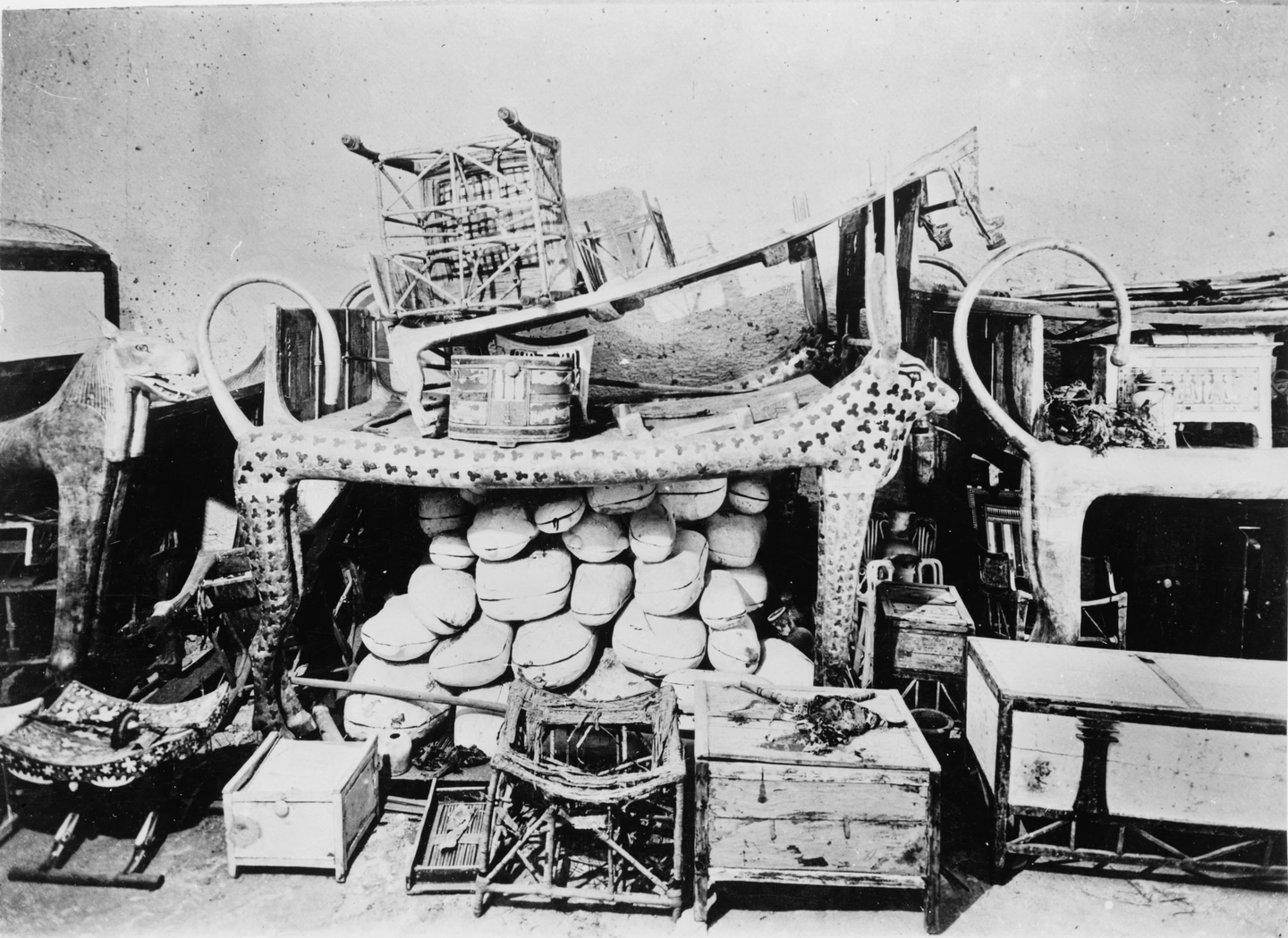
The Library of Congress photograph above was copyrighted on February 26, 1923 (Library of Congress). It shows the antechamber much as Carter’s journal lists it: “gilded couches in strange forms, lion-headed, Hathor-headed, and beast infernal,” chests, stools, and “a heap of large curious white oviform boxes.” That’s the look for your living room: furniture pushed together and piled, not arranged.
The count, and the pictures
Smithsonian puts the final tally at “a mind-boggling 5,398 items,” and says Carter didn’t finish “photographing and recording” them until February 1932. JSTOR Daily says the expedition photographer, Harry Burton, took “approximately 1,800 photographs,” “often deliberately staged,” and “spent time in Hollywood studying lighting techniques” to capture the chambers. Both numbers go into the games below.
The craze
JSTOR Daily quotes archaeologist Frank L. Holt: within months “newspapers were already reporting their influence on Fifth Avenue fashions, as well as a brisk trade in fake tomb artifacts.” Egyptologist Bob Brier, in the same piece, describes Jazz Age women “sporting lead pencils around their necks shaped like pharaohs” and King Tut brand lemons that “didn’t even bother to show Tutankhamun.” It wasn’t the first wave, either: JSTOR Daily notes that “Egyptomania was a fad before the 1920s,” after the Napoleonic expeditions.
Even the president’s dog got the name. JSTOR Daily says Herbert Hoover “named the dog he adopted in 1922 King Tut.” The Library of Congress has a Harris & Ewing photograph from April 12, 1929 captioned “‘King Tut,’ President Hoover’s big German police dog, now makes the rounds of the police sentry boxes in the White House grounds” (Library of Congress). Hoover wasn’t president in 1922, and another 1929 caption in the Library’s collection calls the dog a Belgian police dog, so we’ll only vouch for the dog being at the White House in April 1929.
The Curse, and the Study
Lord Carnarvon died in 1923, and the “curse” was born. Three of the four sources below give a mosquito bite; the fourth, Stebbing, says only “a mysterious illness”:
- The BMJ: “He had developed erysipelas at the site of a mosquito bite, which resulted in septicaemia and pneumonia” (Nelson, 2002).
- JSTOR Daily, 2019: “a mosquito bite that became infected after he cut himself shaving” (JSTOR Daily). Smithsonian’s 2005 piece says the same.
- JSTOR Daily, 2025: Justin Stebbing calls it “a mysterious illness” and suggests a mould, Aspergillus flavus, “may explain the so-called ‘curse’” (JSTOR Daily). That’s one writer’s hypothesis, hedged the way he hedges it.
The newspapers did the rest. The New York Times ran “Carnarvon’s Death Spreads Theories About Vengeance” on April 6, 1923, and Arthur Conan Doyle told it “there are many malevolent spirits,” according to JSTOR Daily. The same piece quotes the scholar Philip Kuberski: the “curse had no foundation in the actual messages deciphered in the burial chambers.” So there’s no real curse inscription to put on a sign, and this party doesn’t invent one.
Nelson tested it anyway. He took “44 Westerners identified by Howard Carter as present in Egypt at the specified dates, 25 of whom were potentially exposed to the curse,” and compared them. “In the 25 people exposed to the curse the mean age at death was 70 years (SD 12) compared with 75 (13) in those not exposed (P=0.87 for difference).” His conclusion: “no evidence to support the existence of a mummy’s curse.” The only thing that predicted a longer life was being a woman. He also points out the idea was older than the tomb: “In 1869 Louisa May Alcott, author of Little Women, had written a short story called ‘Lost in a Pyramid: the Mummy’s Curse.’”
Note who’s missing from those 44. Nelson “included only Western individuals,” so the Egyptian workforce isn’t in the study at all. JSTOR Daily points to the Bodleian Libraries’ exhibition Tutankhamun: Excavating the Archive, which set out to “center the work of Egyptians who were integral to the tomb’s discovery.”
Dressing the House
The doorway (7:30)
Tape brown kraft paper across one interior door frame, floor to top, and draw a row of round seal marks across it in black marker: plain circles, no writing inside them. Put one LED flame light on the floor behind it. At 7:30, the host tears a small hole in the top left corner, the way Carter did, holds the second light up to it, and asks the room, “Can you see anything?”
A low layer of fog on the far side sells the “hot air escaping.” Our fog machine guide covers the settings, and fog and smoke alarms covers the part that matters in a house.
The light
Carter’s candle is the one real flame in the story. At this party it’s an LED, like every other light: there’s burlap on the furniture, fog in the air and 1920s chiffon on the guests. These rechargeable flame lights are the whole lighting plan for the doorway and the dig table.

Ollcuz LED Flame Lights, Rechargeable, 2 Pack
Two flame-effect lights with USB-C charging and a 1,200 mAh battery, which the listing says charges in about three hours. There's no cord to trip over at the paper door, and one can go in the excavator's hand. Three modes: steady, flashing and fast flashing.
Leave them on the steady mode. The two flashing modes are strobes, and our fake fire guide’s section on flicker and photosensitivity explains why a party light shouldn’t flash. For torch sconces and other flame looks, see its campfires, torches and cauldrons section.
The antechamber
This is the living room, piled up like the photograph. Push the furniture together along one wall and stack stools and small chests on top of each other. Throw sand-coloured cloth over everything nobody should sit on: this 40-inch-wide burlap roll is 15 feet long, enough for a sofa and a side table.
No loose sand indoors. That’s our rule, for the floors, the food and anyone in sandals; if you want sand, keep it in sealed glass jars on a shelf.
The only coffin-shaped thing in the house is a closed chest or a cooler, and it stays closed. It holds the ice for the drinks; if that ice goes into glasses, make it a food-safe cooler rather than a painted prop box (our rule).
The dig table
Set up a card table near the door as the registrar’s desk: the register (any notebook), a pencil, the object tags on a string, and a brass magnifier. The registrar checks each guest in and each find in during the game.

Hiceeden 10X Antique Magnifying Glass, Brass with Wooden Handle
A 10x glass lens in a brass-coloured metal frame on a wooden handle, 8.7 by 3.5 inches. It reads fine print, which is all a registrar needs, and it looks like it belonged to the dig.
Roles, Not Peoples
Come as someone at the dig
Everyone comes as someone from the 1922 dig or the 1923 party circuit: the excavator, the photographer, the conservator, the financier, the reporter, an official, a curator, or a guest in evening clothes with a Tut-craze necklace. Nobody comes as “an Egyptian,” ancient or modern, and nobody comes as a named king or queen.
No skin darkening of any kind, for any character. The University of Utah’s costume guidance asks “What’s the historical context of this costume?” and “Does this costume perpetuate stereotypes, particularly racial stereotypes?”, and it asks “Does this costume represent a culture that is not my own?” (University of Utah). A pharaoh or Cleopatra costume fails all three, and so does the classic bronzer “tan.” JSTOR Daily’s own summary of the last hundred years is a century of pop culture “that leaned more into appropriation than appreciation.”
The one monster allowed is the film one. Universal’s 1932 Mummy is a movie character, and our Universal Monsters Night already has the bandaged costume and the koshari. If a guest comes as him, self-adhesive gauze rolls over dark long sleeves do it.
The closed coffin
Museums have been changing how they show mummified people, and the reasons are good ones for a party too. The British Museum says the human remains in its care “are always treated and displayed with respect and dignity” (British Museum). Manchester Museum took a mummified woman called Asru off display in September 2026, after consulting “Egyptian colleagues, members of the Egyptian diaspora and visitors to the Museum,” and gives her own wishes as part of the reason: “Elite Egyptians of her time expected that their mummified bodies would remain wrapped in their coffins, invisible to the living” (Manchester Museum).
So: no unwrapped mummy prop, no prop given a real person’s name or face, the king’s included, and the chest stays shut. We also left the Library of Congress’s photographs of the king’s coffin and body out of this page.
Hats and headbands
We left out the pith helmet. At least one costume version on Amazon is sold as an “Adult British Colonial Pith Helmet,” and a khaki shirt with sleeves rolled and a notebook in the pocket reads as “excavator” without it.
For the party-circuit guests, a beaded 1920s headband does the work.
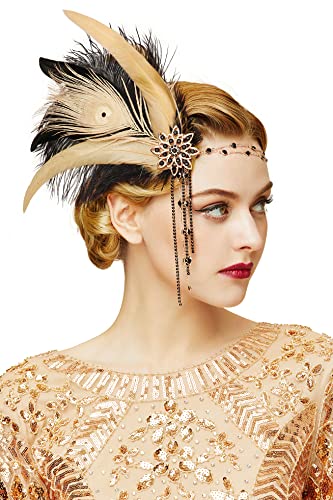
BABEYOND 1920s Feather Crystal Headband
A handmade beaded headband with imitation pearls, two colours of feather, a ribbon band and a gold chain, with a row of black beads across the forehead. One size, and it goes with any 1923 evening dress.
Supper in the Antechamber
Bread, beer and fruit
Bread and beer go together in the Book of the Dead: Chapter I, in Renouf and Naville’s 1904 translation, asks: “O ye who give bread and beer to beneficent souls in the house of Osiris, do you give bread and beer at the two periods to the soul of N who is with you” (Project Gutenberg).
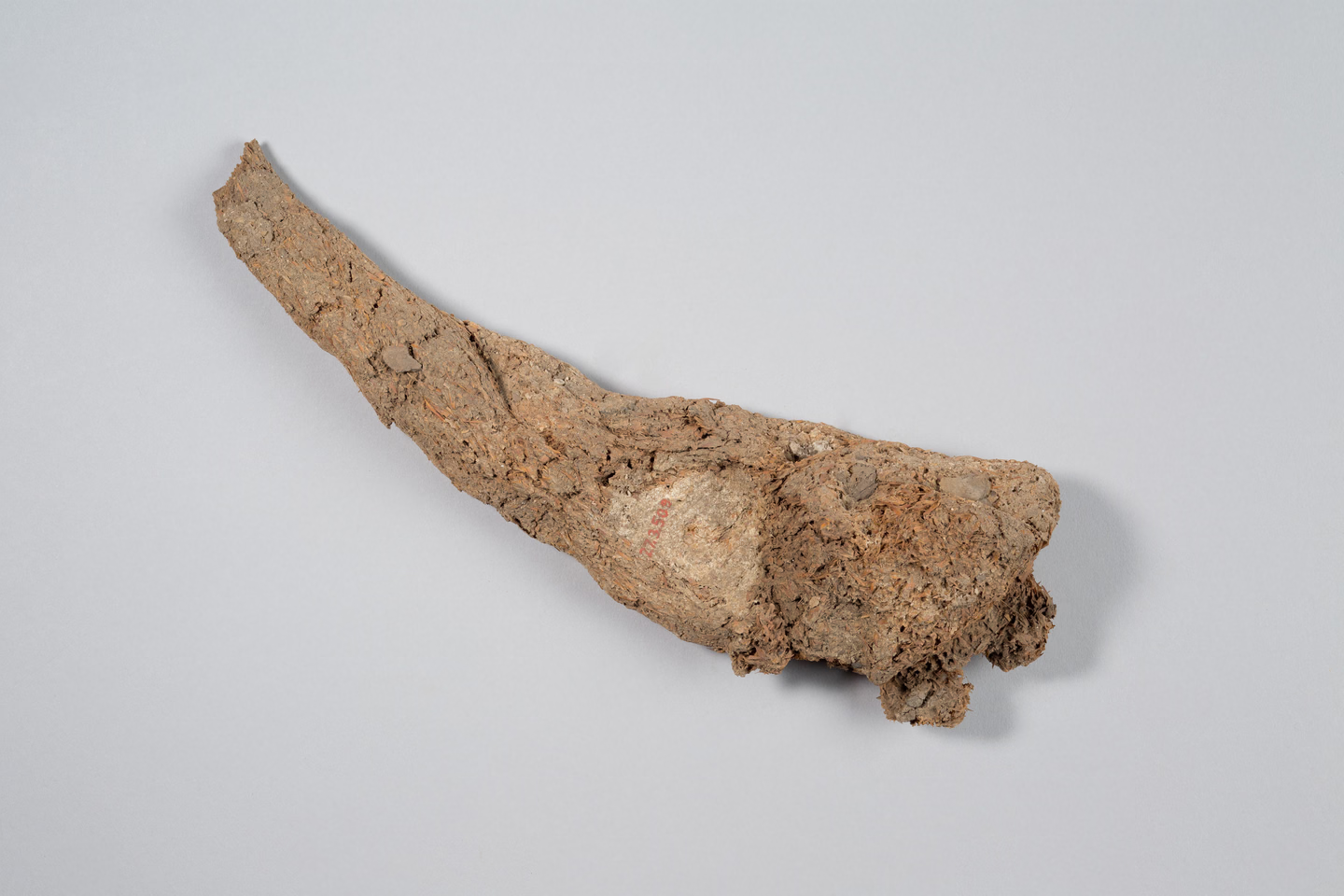
The Met’s finds give you a fruit course. From the same place as the loaf above, which the Met records as a foundation deposit at the Tomb of Senenmut (TT 353) rather than a burial, it holds a Bowl of Figs and a Bowl of Dates, both pottery and both from the 1926 to 1927 excavations, and the loaf itself. Its glass bottle in the form of a pomegranate is Ramesside, about 1300 to 1080 BCE. Set out a board of figs, dates, split pomegranates and a round loaf torn by hand.
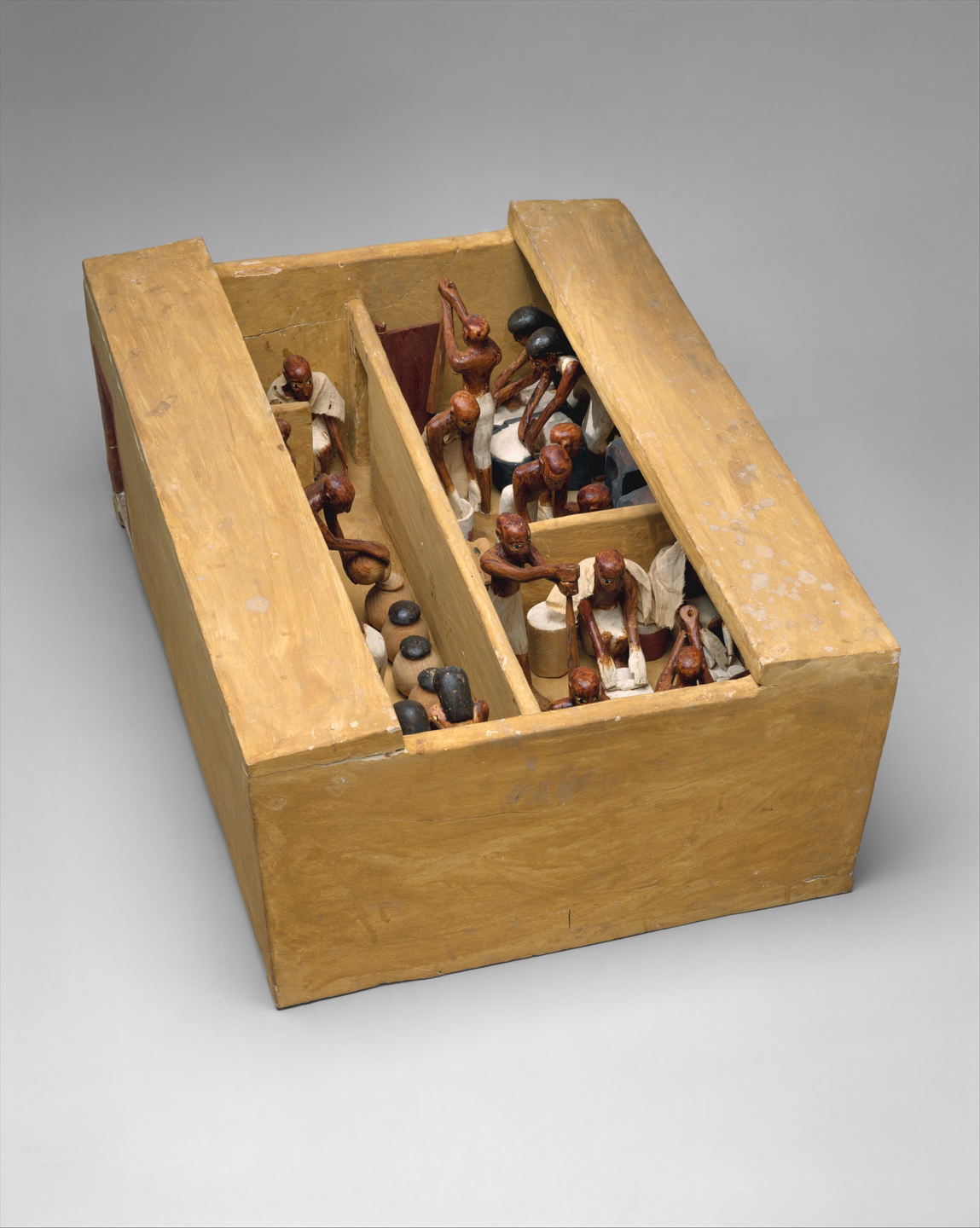
The Met’s Model Bakery and Brewery from the Tomb of Meketre shows the two jobs side by side, in wood, gesso, paint and linen. We don’t claim any modern beer is Egyptian beer; pour whatever you like.
The menu
- Ful medames. America’s Test Kitchen calls it “one of the nation’s most beloved breakfast dishes” and says it “also makes regular appearances as a dip with pita.” Its Ful Medames uses two 15-ounce cans of fava beans simmered with garlic, cumin and tahini for 8 to 10 minutes, mashed, and topped with tomato, onion, parsley and optional hard-cooked eggs. It serves 4 to 6 in 25 minutes; make two batches and keep them warm.
- Dukkah. ATK’s Dukkah is “an Egyptian spice blend” of roasted chickpeas, pistachios, sesame and toasted coriander, cumin and fennel seeds, “traditionally eaten on bread dipped in olive oil.” It “can be stored at room temperature for up to 3 months,” so make it the week before. Serve it in a bowl next to olive oil and torn pita.
- Egyptian barley salad. ATK’s Egyptian Barley Salad is its own dish; ATK says “Inspired by the flavors of Egypt, we incorporated toasty pistachios, tangy pomegranate molasses, and bright, vegetal cilantro.” It’s pearl barley with pomegranate molasses, cinnamon, cumin, golden raisins, cilantro and pistachios, topped with feta, scallions and pomegranate seeds. It serves 6 to 8, so make two.
Koshari is on the Universal Monsters Night menu, if you want a hot main to go with the ful.
Keeping it safe
Serve on small platters and swap them rather than topping them up. The FDA’s buffet advice is to “replace the serving dishes with the fresh ones throughout the party,” keep hot food at “140 °F or warmer,” cold food at “40 °F or colder,” and not leave perishables out more than 2 hours (FDA). The ful and the barley salad (feta) are the two to watch.
The FDA’s nine major food allergens are “milk, eggs, fish, Crustacean shellfish, tree nuts, peanuts, wheat, soybeans, and sesame” (FDA). This menu is heavy on sesame: tahini in the ful and sesame seeds in the dukkah. Pistachios (tree nuts) are in the dukkah and the barley salad; ATK says “for a nut-free version, substitute unsalted sunflower seeds for the pistachios” in the dukkah. The pita and the loaf are wheat; the feta is dairy; the eggs on the ful are optional. For guests who avoid gluten, the barley salad, the pita, the loaf and ordinary beer are all off the list (barley and wheat are gluten grains), so keep the ful, the fruit board, the hibiscus tea and the dukkah with vegetables for them. Label every dish.
The Bar
Hibiscus, two ways
ATK’s Hibiscus Iced Tea steeps 1 1/2 ounces of whole dried hibiscus flowers with orange and lemon zest, ginger, cinnamon, star anise and a clove for about 20 minutes, sweetened with cane syrup. It makes 5 cups and “can be refrigerated for up to 10 days.” It isn’t an Egyptian recipe, and ATK doesn’t say it is: “Hibiscus teas have roots in West Africa and have long been incorporated into Juneteenth celebrations in the United States.” It’s on this menu because it’s dark red and it keeps.
Make three batches: one for a no-alcohol pitcher, labelled, and two for the Hibiscus Tea Cocktails, where each glass gets “6 ounces of tea and 1½ ounces of rum” over ice, with mint and a lemon wheel. ATK says the recipe “can be doubled.”
NIAAA defines a standard drink as “about 14 grams, or about 0.6 fluid ounces, of pure alcohol,” the amount in “a 1.5-ounce shot glass of distilled spirits at 40% alcohol by volume” or “a 12-ounce can of regular beer at 5% alcohol by volume” (NIAAA). With an 80-proof rum, one cocktail is one standard drink, and so is one regular beer. An overproof rum changes that, so check the label.
The scent
Plutarch, writing about Egyptian temple rites in “Of Isis and Osiris,” says “they offer incense to the sun three times every day; resin at his rising, myrrh when it is in the mid-heaven, and that they call Kyphi about the time of his setting.” He lists kyphi as “a kind of a composition made up of sixteen ingredients, that is, of honey, wine, raisins, cyperus, rosin, myrrh, aspalathus, seseli, mastich, bitumen, nightshade, and dock,” plus “the berries of both the junipers,” calamus and cardamom (William Baxter’s translation, in Plutarch’s Essays and Miscellanies, Vol. 4, Project Gutenberg). Read it aloud at sunset if you like. Don’t burn anything: no incense, no resin, no candles, in a house full of fog, burlap and costumes. That’s our rule.
The Music
The Library of Congress’s National Jukebox streams records from the Tut years:
- “Old King Tut,” by Harry Von Tilzer with lyrics by William Jerome, sung by Ernest Hare and Billy Jones and recorded April 14, 1923 (Library of Congress), and a dance-band version by The Georgians, led by Frank Guarente, recorded April 27, 1923 (Library of Congress). That’s the 11:00 song.
- Johann Strauss’s “Egyptian march,” by the Goldman Band under Edwin Franko Goldman, recorded September 12, 1922, two months before the step (Library of Congress).
- Verdi’s “Grand march” from Aida, by Vessella’s Italian Band, recorded November 5, 1912 (Library of Congress). The Library’s Katherine Dunham essay notes that “Aida had its premiere at the Cairo Opera House on Christmas Eve 1871” (Library of Congress).
Between those, our Oldies playlist keeps people dancing.
Running the Evening
7:00 PM: The step
Send the Egyptian Tomb invitation three weeks ahead. At the door, the registrar hands each guest their object tag and a role: Excavator, Photographer, Conservator, Registrar, Draughtsman, Chemist, Financier, Reporter, Curator, Surveyor, Cook, Official. Nelson’s list of who was there, “members and relatives of Carnarvon’s and the Metropolitan Museum of Art’s excavation teams, the press, Belgian royalty, British officials and dignitaries, and experts employed by the Egyptian government,” covers every one of them.
7:30 PM: Seals intact
Everyone gathers at the paper door. The host reads Carter’s cable, tears the small hole, holds up the LED light and waits for someone to ask, “Can you see anything?” Answer with the journal’s line, “Yes, it is wonderful,” then tear the door down.
8:00 PM: Supper
Everything goes out at once in the antechamber, with the fruit board next to the beer.
9:00 PM: The registration game
Before the party, print picture cards of the Met objects linked on this page: the loaf, the figs, the dates, the pomegranate bottle, the brewery model, and a glass pomegranate pendant from the Palace of Amenhotep III at Malqata. The Met marks all of them public domain. Hide them around the antechamber. Guests find them, bring them to the dig table, and the registrar logs each one with the finder’s name and a tag. Whoever registers the most finds gets tag No. 5,398, Smithsonian’s grand total, as the prize.
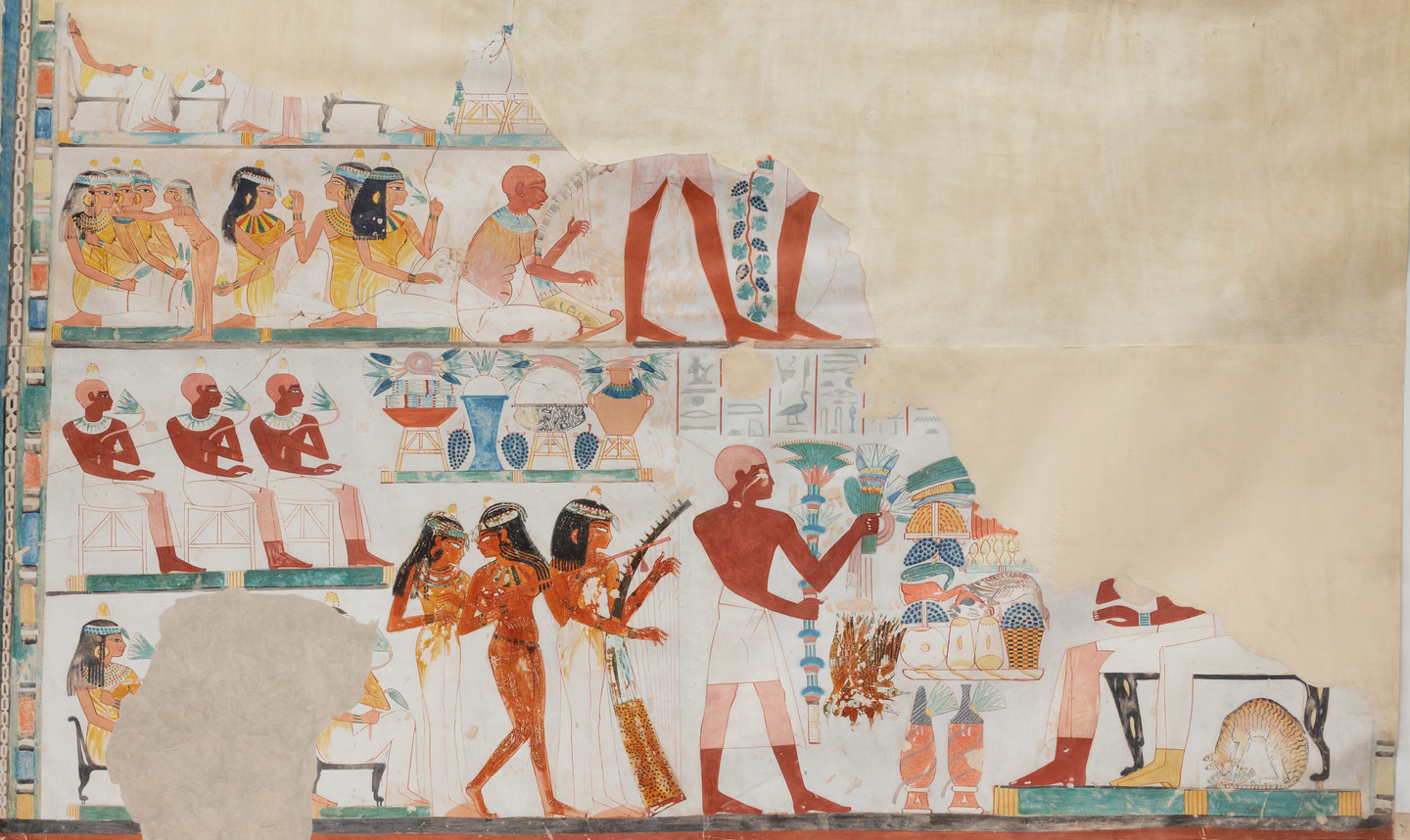
The banquet copy above is a good card to hide too: the Met’s Banquet Scene with Musicians is a full-scale copy by the Met’s Graphic Section, painted between 1908 and 1914, years before the Tut excavation.
10:00 PM: Curse or Mosquito?
Read these aloud; guests shout “Curse” or “Mosquito.” The answers are all from the sources above.
- Louisa May Alcott wrote a mummy’s-curse story before the tomb was found. (True: 1869, per Nelson.)
- Nelson found that people at the tomb’s openings died significantly younger. (False: P=0.87, “no evidence.”)
- Women in the study lived longer than men. (True: “Female sex was a predictor for survival.”)
- Carter found a curse written in the burial chamber. (False: Kuberski, via JSTOR Daily.)
- Carnarvon’s death began with a mosquito bite. (True in three of the four sources here; Stebbing says “a mysterious illness.”)
- A mould explains the curse. (Disputed: one writer’s “may explain.”)
- Burton took about 1,800 photographs. (True, per JSTOR Daily.)
11:00 PM: Old King Tut
Put on the 1923 record and clear the floor.
Costume Guide
- The excavator. Khaki shirt and trousers, rolled sleeves, a notebook in the breast pocket and the LED flame light. It’s the host’s costume, since the host breaks the door.
- The photographer. Any old camera on a strap. Burton, per JSTOR Daily, studied lighting in Hollywood; carry a second LED light as the “lamp.”
- The conservator. An apron, cotton gloves and a soft paintbrush.
- The financier and the official. A three-piece suit or tweeds, a pocket watch, and a ledger.
- The reporter. A notebook, a pencil behind the ear and a card reading PRESS in the hatband.
- The party circuit. A 1923 evening dress or dinner jacket, the headband above, and a pencil on a chain in honour of Brier’s Jazz Age women.
- The film Mummy. Gauze over dark clothes, never tight at the neck, wrists or ankles, per our Universal Monsters Night guide.
Our costume contest ideas work well here with one category: best role on the dig.
Production Notes
Budget Breakdown: Food for twelve, two batches of ful, the dukkah, two barley salads and the fruit board, comes to about $100. Rum, beer and three batches of hibiscus tea add about $60. The two LED lights, the burlap and the magnifier are about $58, and cardstock, envelopes and kraft paper about $30. That’s a floor of about $250. The headband ($15), the gauze ($17) and a second pair of LED lights ($25) take it to about $310.
Advance Prep: Send invitations three weeks out. Make the dukkah the week before. Print and cut the tags and the object cards the weekend before. Brew the tea up to ten days ahead. Make the barley salad and tape up the paper door in the afternoon; the ful goes on at 7:30.
What to Skip: Real flame anywhere, incense included. Loose sand. Any costume of a people rather than a role, and any skin darkening. An unwrapped mummy prop, or any prop with a real person’s name or face. Invented “curse” inscriptions: the burial chamber didn’t have one.