Egyptian Tomb Object Tag Place Cards
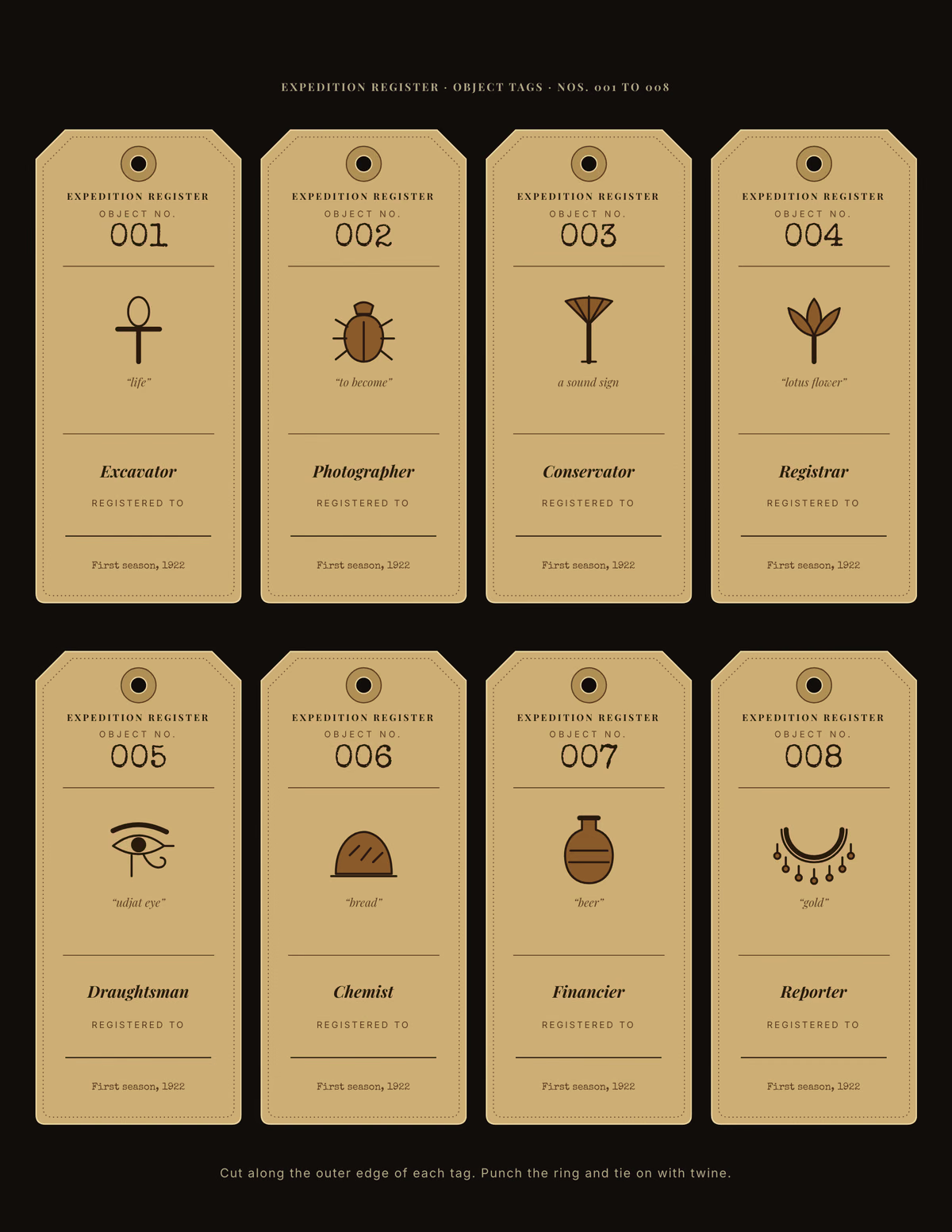
Printable place cards shaped like manila object registration tags from a 1922 dig, 4.25 inches tall: twelve roles from Excavator to Official, three Guest of the Expedition tags, and a spare No. 5,398.
Download Files
What You'll Need To Use This
-

Neenah Exact Index Card Stock, 110 lb, 8.5 x 11, 250 Sheets
A 110 lb index stock, heavier than standard 65 lb cardstock per the listing, for tags that get handled all evening.
$15.62 Price as of Sep 29, 2026
View on Amazon: Neenah Exact Index Card Stock, 110 lb, 8.5 x 11, 250 Sheets -

Swingline 1 Hole Punch, 5 Sheet Capacity
A single-hole punch for the printed ring at the top of each tag.
$5.59 Price as of Sep 29, 2026
View on Amazon: Swingline 1 Hole Punch, 5 Sheet Capacity
Sixteen place cards on two letter sheets, each shaped like the manila tag a dig team tied to a find before it went into the register. Every tag has an object number, one small drawing, a role on the expedition and a line for the guest’s name. They go with the Egyptian Tomb party blueprint and the Egyptian Tomb invitation.
The Roles
- Sheet 1: No. 001 Excavator, 002 Photographer, 003 Conservator, 004 Registrar, 005 Draughtsman, 006 Chemist, 007 Financier, 008 Reporter
- Sheet 2: No. 009 Curator, 010 Surveyor, 011 Cook, 012 Official, three tags for a Guest of the Expedition, and No. 5,398
The roles come from who was there. Mark R. Nelson’s 2002 study of the “mummy’s curse” in the BMJ lists the Westerners Carter recorded at the tomb as “members and relatives of Carnarvon’s and the Metropolitan Museum of Art’s excavation teams, the press, Belgian royalty, British officials and dignitaries, and experts employed by the Egyptian government” (BMJ, via PMC). Every tag is a job, not a nationality and not a real person’s name. The numbers 001 to 015 are ours, not Carter’s.
No. 5,398 is the joke. Smithsonian puts the tomb’s recorded total at “a mind-boggling 5,398 items,” and Carter didn’t finish recording them until February 1932 (Smithsonian). Give that tag to whoever arrives last, or to the host.
The Drawings
Each tag carries one small drawing: an ankh, a scarab, a papyrus stem, a lotus, an udjat eye, a loaf, a beer jar, a broad collar or a sun disk. We drew them ourselves as simple line art. They aren’t traced from a sign list or set in a hieroglyph font, and no tag combines two signs into a word or puts anyone’s name in an oval.
The one-line caption under each drawing is the meaning the Unicode Standard’s names list gives for the matching Egyptian sign (Unicode 18.0, Egyptian Hieroglyphs): the ankh is “logogram (life)”, the scarab “logogram (to become)”, the loaf “logogram (bread)”, the jar “logogram (beer)”, the collar “logogram (gold)” and the disk “logogram (the sun, Re)”. The lotus is listed as “classifier lotus flower”, the eye as “logogram (udjat eye)”, and the papyrus stem only as a “phonemogram”, a sound sign, so that’s what its caption says. The block’s header notes that its signs “are taken primarily from Alan Gardiner’s works on Middle Egyptian.”
Cutting and Hanging
Print at actual size. Cut around the outer edge of each tag, clipped corners included, then punch out the hole inside the printed ring with a 1/4-inch hole punch. Thread twine through and tie the tag to a chair back or around a rolled napkin. Write names in dark ink on the manila of the dark version, or in black on the light one.
For a registration game, tie a tag to each of the object picture cards described in the blueprint instead, and let guests claim them. The Halloween table setting ideas cover the rest of the table.
Guides That Use This Printable

Accessible Trick-or-Treat: A Porch Every Kid Can Reach
Why the candy should come down to the walk instead of a ramp going up, what hangs where a white cane can't find it, how to light the path for low vision without strobing anyone, and how to run a teal bowl, a quiet hour and a sign kids can actually read.
How Much Halloween Candy to Buy (And the Bag-Count Trap)
Why the famous candy formula's per-bag number is wrong, how to count your trick-or-treaters this year so next year's estimate is real, the per-piece math on common bags, and what to do with the leftovers.
How to Host a Halloween Dinner Party That People Actually Talk About
A complete guide to throwing a Halloween dinner party for adults, from atmospheric lighting and sound design to menu planning and the arc of an unforgettable evening.