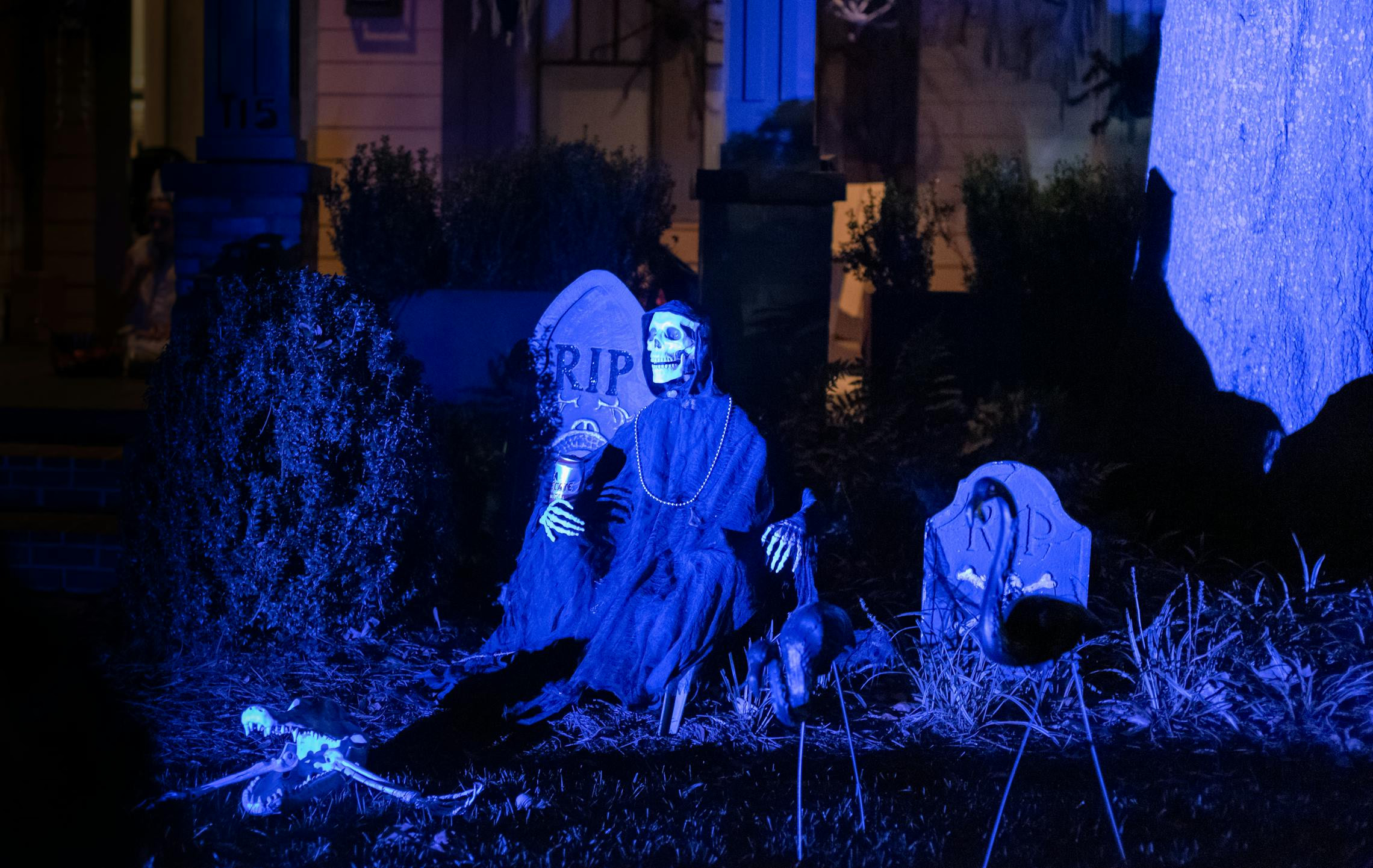
Opening a garage or backyard walkthrough to the public puts you in front of four offices that never cared about your front-yard skeleton: the fire marshal, the police, your insurer and, if money changes hands, the IRS. Where one of them has put a rule in writing, we quote it. Where none has, we say what we’d do and label it as ours.
None of this is legal or insurance advice. Fire codes, permits and policies are local and personal: your city’s fire marshal, your city and your insurer’s written answer are what apply to you. We quote one city’s actual haunted-house rule so you can see what a fire marshal asks for, then go ask yours.
HOA covenants, noise limits, light trespass, sidewalk clearance and the note to the houses next door are in Halloween decorations vs. the neighbors.
When a Home Haunt Needs a Permit
We looked for a city or fire-district rule that exempts haunts at private homes and didn’t find one. What we found instead is a rule with no size floor at all.
Portland: every haunted house, regardless of size
Portland Fire & Rescue’s permit page says: “A permit from the Fire Marshal’s Office is required for Haunted Houses, or similar temporary installations regardless of occupant load” (Portland Fire & Rescue, 300.08RHH). Every other event on its public-assembly list has a threshold: over 500 people in an assembly building, over 49 in a non-assembly building or a fenced outdoor area. The same list ends with “All haunted houses, regardless of occupant load” (Portland, public assembly permits).
The adopted rule behind that page is FIR 3.03, “Haunted Houses and Similar Temporary Installations,” in effect since 1993 and last revised in 2018. Its scope is “Haunted Houses and similar functions that will be attended by members of the public,” and it applies to installations “set up for 90 days or less inside a structure not designed for this specific use” (Portland FIR 3.03, PDF).
FIR 3.03 never mentions homes, garages or residences. Our reading: a garage walkthrough open to the neighborhood is a haunted house, inside a structure not designed for that use, attended by members of the public. We found nothing in Portland’s rule or on its permit pages that exempts it.
Other fire departments say much the same
- Sacramento Metropolitan Fire District applies its haunted-house regulations to “temporary haunted houses, ghost walks or similar amusement uses, where decorative materials and confusing sounds and/or visual effects are present,” wants plans 30 days ahead, and says “No permits will be issued for events without plan review approval” (Sac Metro Fire, Haunted House Regulations 2023).
- Livermore-Pleasanton Fire Department requires an operational permit for haunted houses under the California Fire Code, a fire permit application 14 days before the event, and fees of $358 per lot in Livermore and $265 in Pleasanton. Its guide is written for schools, PTAs, fundraisers and churches (LPFD, Haunted House & Amusement Building Guidelines).
- Santa Clara County Fire Department, in a standard last revised in 2011, defines a “Ghost Walk” as “Similar to a Haunted House and may include both indoor and outdoor areas,” so an outdoor maze isn’t automatically outside its standard (SCCFD, Haunted Houses/Ghost Walks).
None of the three mentions private residences either way.
The model code: garage versus open yard
Many state and local codes are adopted from the International Code Council’s model codes; Sacramento Metro’s rule, for one, cites the 2022 California Fire Code. The 2021 International Building Code defines a “special amusement area” as a building or part of one “occupied for amusement, entertainment or educational purposes” and arranged so that it “Intentionally confounds identification of the means of egress path” or makes the way out “not readily apparent due to visual or audio distractions” (ICC, IBC 2021 chapter 2).
Section 411 then carves out the open yard: “Special amusement areas that are without walls or a roof and constructed to prevent the accumulation of smoke need not comply with this section” (ICC, IBC 2021 section 411).
Our reading of the two together: walls and a roof are what turn a yard path into a regulated amusement building. A garage has both. A pop-up canopy tunnel or a black-plastic maze with a roof may too. The IBC is a model code that each state and city adopts and amends, and Santa Clara reaches outdoor ghost walks anyway, so take the distinction to your fire marshal as a question, not an answer.
The calendar
FIR 3.03 says the permit itself “shall be obtained from the Fire Marshal’s Office at least 21 days before the event is opened to the public.” The paperwork deadline is on Portland’s permit pages: “A complete application packet (including fees and plans) must be received at least 21 calendar days before the event,” and “Any permit request packet received after the deadline may be charged DOUBLE FEES ($500.00 MAX)” (Portland, special event permit form). The haunted-house page adds that the floor plan “must be submitted with the permit application packet at least 21 days before the event” (300.08RHH).
Count back 21 days. A haunt opening Saturday, October 24 needs its packet in by Saturday, October 3. One opening Friday, October 30 needs it by Friday, October 9, and one opening Saturday, October 31 by Saturday, October 10. Portland’s Permit Center is open “Monday through Thursday 11:00am to 3:30pm” and “Closed on Fridays,” so if you’re filing in person, all three deadlines land on a day it’s closed: go the Thursday before.
Sacramento Metro says to “Allow 30 days for plan review,” and plans submitted later “shall pay the required fees for an expedited plan review.” For an October 24 opening, that window closed September 24. For October 31, it closes October 1.
Portland’s fees are “calculated based on the square footage of actual area in use by the public.” The smallest tiers are $200 for up to 25,000 square feet in an assembly building and $300 in a non-assembly building (300.08RHH).
What to ask your fire marshal
Call the fire prevention or special-events office, not 911 and not the station down the street. Our list:
- Does a haunted walkthrough at a private home, free to the public, need a permit here? Does the answer change if it’s in the garage, or if we take donations or charge admission?
- Which code section or local rule applies, and can you send it?
- How many days ahead do you need the application and floor plan?
- Do you inspect before opening, and what will the inspector check?
- What flame retardant treatment do you accept for fabric, hay and cornstalks?
Get the answer in an email. If the office says no permit is needed, that email is what you show a neighbor, an insurer or an officer who asks.
What a Fire Marshal Looks For
Portland’s FIR 3.03 is the most complete haunted-house rule we read, so here it is item by item. Where Portland’s web summary words something differently from the adopted PDF, we quote the PDF and note the difference.
Exits and signs
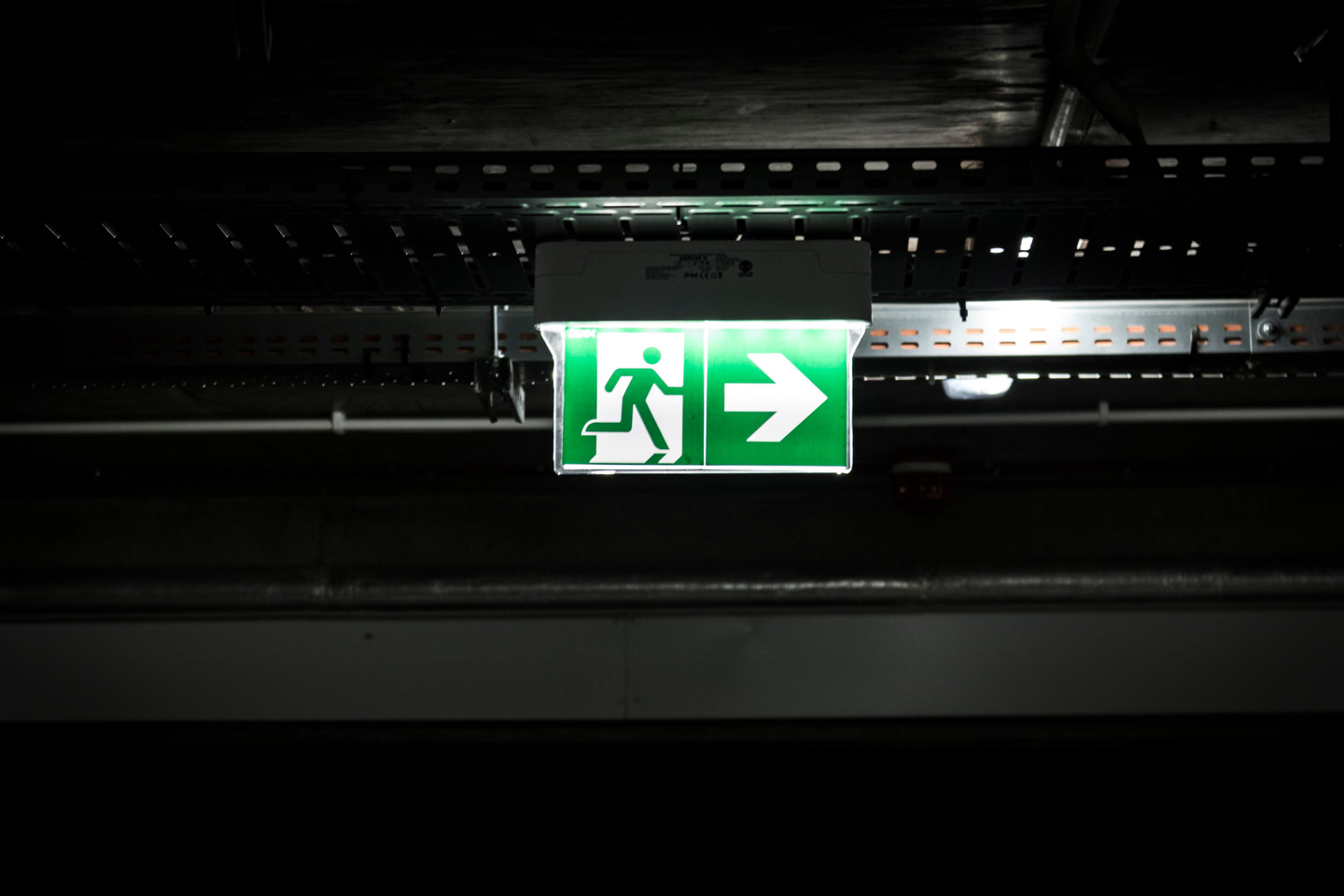
- Exits “Shall be a minimum of 3’ wide and 6’ 8” in height.”
- Each exit gets a lighted sign above it, either “Electrically powered with a battery back-up” or “Made of a heavy paper/cardboard with 12” fluorescent red letters on a white background.” For the paper sign, “a flashlight or spotlight shall be mounted to illuminate the sign when the facility is open to the public.”
- “All stairways must be illuminated at a level of at least one footcandle (one-fifth of normal exit lighting power).”
- “Blocking, locking or in any way impeding ready access to any marked or required exit is prohibited. All exitways shall be kept clear of any obstructions or storage.”
A painted cardboard sign lit by a clamp light meets the letter of Portland’s rule, so a hardwired commercial fixture isn’t the only option. The web summary adds a practical note the PDF doesn’t have: electric signs “should be plugged in a few hours before the event to charge the batteries.” It also describes the electric option as having “two emergency lights,” which the PDF doesn’t require.
The IBC goes further where a maze hides the way out: “approved and listed low-level exit signs” and directional path markings “located not more than 8 inches (203 mm) above the walking surface” (section 411.6). Glow tape on a step edge is a trip marker, not a listed exit sign.
Mazes
- “There may be no dead-end corridors.”
- “There must be an obvious exit out of the maze every 50 feet of linear travel.” (The web summary says “approximately every 50 feet.”)
- “All aisles must be a minimum of 4’ wide and 6’8” inches high.”
Our yard haunt basics sets a tighter target by choice: every point within 20 feet of a clear, lit exit.
Sprinklers: two conditions, both required
FIR 3.03 starts with “The building shall be equipped throughout with automatic sprinkler and fire detection systems.” The exception: “Automatic sprinklers are not required where the total floor area of the building is less than 1,000 square feet and the travel distance from any point to an exit is less than 50 feet.”
That’s an “and.” A small garage that meets the square footage but routes guests through a long switchback can fail on travel distance. And the exception drops only the sprinklers: fire detection is still in the first sentence. The IBC’s temporary-haunt exception uses the same two numbers (section 411.2). Sacramento Metro lets temporary haunts use “Single station smoke alarms,” with quantity and spacing “based on manufacturer’s specifications.”
Fire, fabric and harvest decor
- “There shall be no smoking allowed at any time by anyone inside the building or structure.”
- “No open-flame devices or temporary heaters shall be allowed in the occupancy.” (The web summary adds “unless prior approval is obtained from the Public/Special Events Inspector.”)
- “Use of untreated combustible material is prohibited.” (The web summary adds “including non-flame retardant visqueen,” the black plastic sheeting many haunts use for walls.)
- “All combustible material shall be treated or protected so that it is essentially rendered and maintained flame-retardant in a manner acceptable to the Fire Marshal’s Office. This includes all harvest decorations such as cornstalks, dry branches, and hay. These types of decorations are never to be placed in or near exitways or stairs.”

The entrance tunnel of hay bales and cornstalk walls is exactly what Portland is describing. The NFPA says “Dried flowers, cornstalks, and crepe paper catch fire easily” and counts decorations as “the first thing to ignite in more than 800 reported home fires each year” (NFPA Halloween safety tips). Sacramento Metro wants decorative materials “flame resistant or treated with approved CSFM listed flame retardant,” and Livermore-Pleasanton says “Foam plastics or exposed polyurethane foam decorations are prohibited unless properly protected.”
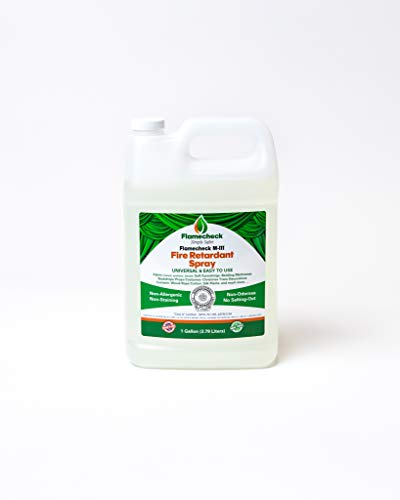
Flamecheck, the maker of M-111, lists “Hay & Straw” and “Dried and Silk Flowers” among its applications, and says it can add a fluorescent dye so “a Fire Marshal/Inspector” can check treatment with a black light (Flamecheck’s product page). Flamecheck adds the dye “at no additional charge” on orders from its own site; the Amazon gallon below doesn’t list it. Cornstalks aren’t on its list, which is one more reason to ask your fire marshal what treatment they accept before you spray. Flamecheck also says “Laundering will remove Flamecheck M-111.” Our flame retardant sprays section covers how the common sprays wash out in rain and how to test a sample.
Fire extinguishers
- “The maximum travel distance to an extinguisher cannot exceed 50 feet.”
- “The minimum acceptable extinguisher classification (size) is 2A-10BC.”
- “All fire extinguishers shall have a service tag showing servicing within the last year, unless it is new.”
- Mounted “in a conspicuous location, near each required exit.”
- “Staff shall be instructed in the proper use of extinguishers.”
Sacramento Metro and Livermore-Pleasanton also set 2-A:10-B:C as the minimum. The US Fire Administration explains that “The number before the ‘A’ represents a multiple of 1.25 gallons of water,” and uses a 1A:10B:C unit as its example (USFA, fire extinguishers). A 1-A:10-B:C unit, USFA’s own example, has half the Class A rating these fire departments ask for. Read the rating on the label, not the size of the can.
USFA gives a checklist before anyone fights a fire: “Have I alerted others in the building that there is a fire?”, “Has someone called the fire department?”, “Am I physically able to use a fire extinguisher?”, “Is the fire small and contained in a single object or to a surface (like a pan or a wastebasket)?”, “Am I safe from the fire’s toxic smoke?” and “Do I have a clear escape route?” Use it “when all of these questions are answered ‘yes.’” Otherwise, “alert others, leave the building, and call 911 from a mobile or neighbor’s phone.” Teach it with PASS: “Pull the pin,” “Aim low,” “Squeeze the lever slowly and evenly,” “Sweep the nozzle from side-to-side.”
Groups, Kids and Staff
FIR 3.03 caps groups: “A group shall consist of not more than 20 persons, as determined by the Public/Special Events Inspector.” And for children: “Each group of children age 12 and under must be accompanied and supervised by a staff person who is 18 years of age or older. This staff person must have in their possession an operable flashlight and shall be completely familiar with the facility.” Portland’s web summary says “accompanied or supervised,” which reads looser. The adopted PDF says “and.”
Even where no rule applies, we’d run a home haunt that way:
- Send groups, not a stream. A greeter at the entrance holds each group until the one ahead clears the first scare.
- An adult with a flashlight goes with every group of young kids, or the group’s own parent does.
- One adult out of costume, all night. They carry the first aid kit and a radio, know the evacuation plan, and never take a scare position.
- Actor rules stay the same at home. No touching, a safe word, breaks. See actor safety rules and the consent section of the psychology of the jump scare.
Teen actors and volunteers
Our rules for minors on the crew: a parent or guardian on site, no minor alone in a scare zone, and an end time that gets them home when their family expects. Pair each teen with an adult actor in a shared zone.
If the haunt charges admission or runs under a nonprofit, volunteer status gets more complicated. The Department of Labor says people “may volunteer time to religious, charitable, civic, humanitarian, or similar non-profit organizations as a public service and not be covered by the FLSA,” but “generally may not, however, volunteer in commercial activities run by a non-profit organization such as a gift shop” (DOL Fact Sheet 14A). Our reading: a free haunt at your house with friends helping isn’t what that fact sheet is about. A ticketed one is worth a question to a lawyer.
Police, Parking and the Street
Know which number is which before opening night. Portland’s emergency center says “If there is an immediate threat to life or property, call 9-1-1,” and describes 9-1-1 calls as situations where the threat is “occurring now.” Its non-emergency line, 503-823-3333, is for situations “not an immediate threat to life or property” (Portland 911, non-emergency). It also says “If you are unsure whether your situation is an emergency, call 9-1-1 and the calltaker will determine whether to handle your call” (Portland 911, when to call 9-1-1). An injured guest, a fire or a fight is a 911 call. A car blocking a driveway isn’t. Find your own city’s non-emergency number and put it on the clipboard at the exit.
The heads-up call
We found no police department page about registering a home haunt, so this is our method. A few days before opening, call your police department’s non-emergency line and tell them:
- the address and the nights and hours you’re open
- the crowd you expect, and whether there’s a line on the sidewalk
- that there will be screaming, sirens on the soundtrack, fog and costumed actors
- a phone number that someone at the haunt will answer all night
Screams after dark and a figure in a mask by the curb are what get 911 calls from people who don’t know about the haunt. The heads-up won’t stop an officer from coming, but it gives dispatch a reason when one does.
Parking and the line
Our method, since no source we read sets rules for a home event:
- Cones only on your own driveway apron, never in the street. Keep hydrants, crosswalks and neighbors’ driveways clear.
- A parking helper in a reflective vest. The CPSC wants costumes “brightly colored or trimmed with reflective tape to make them visible to motorists at dusk and in the dark” (CPSC, Halloween safety). The same logic applies to anyone waving cars around in the dark.
- Queue the line on your side, along your own lawn or driveway, with stanchions and a greeter. For how much sidewalk to leave clear, see sidewalks, streets and fog.
- Post a closing time and cut the line 15 minutes before it. The greeter tells the last person in line.
A Southern California home haunt, the Gershon Dungeon, asks visitors on its site to “be considerate of neighbors when parking on street” and to “pickup trash!” (Haunted Attraction Network). The same roundup counts 127 home haunts on the SoCal Haunt List, of which “only one of them lists an admission price.” Rotten Apple 907 in Burbank “welcomed more than 4,000 people in 2021.”
Closing the street
Portland’s transportation bureau issues a free block party permit for Halloween. It says to “apply for your permit at least 15 days in advance,” that only “Local Service Traffic streets” qualify, that “Your street closure must maintain a 12-foot-wide fire lane throughout the closure,” and “If your closure continues into evening, you must use approved barricades with flashing lights.” PBOT “does not provide traffic control devices” (PBOT, Halloween block parties). Never close a street with sawhorses and a sign on your own authority.
Insurance: Free, Donation or Ticketed
Homeowners and renters policies have two parts that matter here. The NAIC describes personal liability as protection “against claims arising from accidents to others on property that you own or rent,” and medical expense coverage as “limited to an amount per person and per accident for injuries occurring on your premises to persons other than an insured.” It adds: “An important feature of this coverage is that payment is made regardless of legal liability” (NAIC, homeowners insurance).
The limits can be small. The California Department of Insurance says renters policies are “generally subject to a minimum of $100,000” for personal liability and “Generally Subject to a minimum of $1,000” for medical payments to others (CDI, Residential Insurance guide). NAIC says you can add liability and medical payments coverage “for a nominal premium.”

Where charging admission changes things
The CDI’s description of medical payments coverage includes: “It is not a substitute for health insurance. Business activities are also excluded.” Liability coverage “will not protect you in all situations, such as an intentional act.” NAIC is blunter about home businesses: “Failing to disclose a home-business to your insurer could lead to a cancelled policy.”
Our reading: a free haunt for the neighborhood looks like the guests any homeowner has. A ticket booth looks like a business activity, and that is the tripwire for the exclusions above. A donation box in between is a question only your insurer can answer. Ask before you open.
What the haunt industry’s insurers say
Cameron Annas of Granite Insurance, which sells coverage to haunted attractions, told the Haunted Attraction Network about a haunted-house policy his team reviewed: “it says, ‘Hey, here’s your liability policy,’ but guess what it excludes? Haunted houses.” On touching: “people that want touching, and guess what is excluded on their policy? Abuse and molestation, assault, and battery are the only things that could come about from touching.” For operators who don’t own their building, he says “you need to be starting these conversations two months before you start to set up” (Haunted Attraction Network, Granite Insurance). He was talking about commercial haunts, and Granite sells the coverage it describes, but the touching point carries straight to a home haunt: the no-touch rule protects your coverage as well as your guests.
Call your insurer in writing
Our method. Email your agent or insurer before you build, and describe the event plainly:
- the dates, hours and number of nights
- where it is (garage, backyard, front yard) and how many people you expect
- whether it’s free, donation-based or ticketed, and who gets the money
- whether volunteers or minors act in it, and that actors don’t touch guests
- whether you’re closing a street or have a fire marshal permit
Ask three questions: Is this covered under my current policy? What are my liability and medical payments limits? If it isn’t covered, what would cover it? Keep the reply with your fire marshal email.
Liability: What Two State Laws Say
This is where we most need to repeat that we’re not lawyers. Two state statutes show the basic shape. California’s Civil Code §1714(a) says “Everyone is responsible, not only for the result of his or her willful acts, but also for an injury occasioned to another by his or her want of ordinary care or skill in the management of his or her property or person” (Cal. Civ. Code §1714).
Florida’s §768.075 limits a property owner’s liability to trespassers, and in doing so describes what makes someone more than a trespasser. Status isn’t raised to that of an invitee “unless the person or organization owning or controlling an interest in real property has issued an express invitation to enter the property or has manifested a clear intent to hold the property open to use by persons pursuing purposes such as those pursued by the person whose status is at issue.” Paragraph (3)(c) adds: “This subsection shall not be interpreted or construed to alter the common law as it pertains to the ‘attractive nuisance doctrine’” (Fla. Stat. §768.075).
Our reading: a flyer, a sign saying “Open 7 to 10” and a line on your lawn may look like the express invitation that sentence describes, so the trespasser immunity isn’t the part of the statute that fits a home haunt. What attractive nuisance and invitee status mean where you live is a question for a lawyer there.
Waivers
Our opinion, not a legal one: a waiver at a free neighborhood haunt mostly tells guests the haunt is intense, and it doesn’t replace clear exits, lit steps and a no-touch rule. Whether a waiver protects you at all depends on your state’s law and its wording. If you’re thinking about one, talk to a lawyer. For how extreme haunts differ from the rest of the industry, see the rise of the modern haunt industry.
Charity Haunts and Donation Jars
Many home haunts collect for charity. Rotten Apple 907 “gives 100% of its donations to a charity,” and Gothic Hills Cemetery “asks for non-perishable food or pet supplies” (Haunted Attraction Network).

The IRS lists “A contribution to a specific individual” among the contributions you can’t deduct (IRS Pub. 526). Our reading: cash dropped in a jar that you, the homeowner, collect is a gift to you, even if you write the shelter a check on November 1. Visitors who want a deduction need to give to the charity itself, by its own box, envelope or donation link. Check that the charity qualifies at IRS.gov/TEOS, a tool Pub. 526 describes as one that “will enable you to search for qualified organizations.”
If the charity itself runs the haunt or collects at the door, its rules apply:
- A “donation” that buys entry is partly a payment for entry. The IRS calls it a quid pro quo contribution, “a payment a donor makes to a charity partly as a contribution and partly for goods or services.” Its example: $100 for a $40 concert ticket is a $60 contribution (IRS, quid pro quo contributions).
- Over $75 triggers a disclosure the charity has to give. “The penalty is $10 per contribution, not to exceed $5,000 per fundraising event or mailing.”
- $250 or more needs a written acknowledgment. Donors need “a contemporaneous written acknowledgment from a charitable organization for any single monetary contribution or noncash contribution valued at $250 or more” (IRS Pub. 1771).
If you keep admission money, it’s income. The IRS says “If a taxpayer receives income from an activity that is carried on with no intention of making a profit, they must report the income they receive on Schedule 1, Form 1040, line 8” (IRS, hobby or business).
First Aid and the Exit Spotter
This section is our method. None of our approved sources sets a first aid standard for a home event.
- A first aid kit at the exit, not in the house. Bandages, gauze, tape, an instant cold pack, gloves, and a flashlight at minimum.
- An exit spotter in regular clothes and a reflective vest, holding the kit, a radio and the phone. Guests who want out go to them.
- Radios for three posts: the entrance greeter, the exit spotter and whoever runs the house or the soundtrack. One agreed word from any post, such as “Lights,” brings the house lights up and stops the scares.
- A clear route for an ambulance crew: a lit path from the street to the door that no prop, cord or line crosses, and house numbers they can read from the street. Sacramento Metro requires address numbers “a minimum of 6-inches in height, internally or externally illuminated.”
- Glow tape on step edges and trip hazards the path can’t avoid. Our yard haunt basics covers cords and GFCI power.
The Kit
Check your fire marshal’s list before you buy.
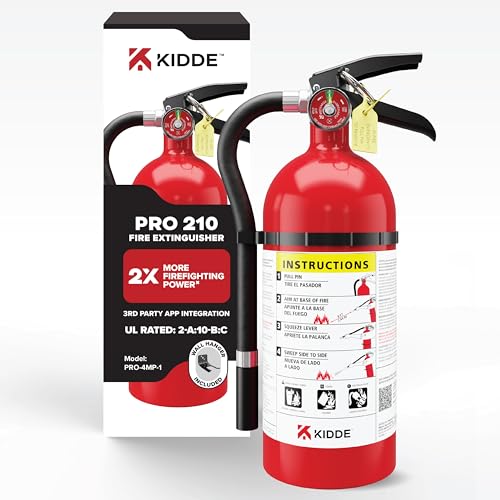
Kidde Pro 210 Fire Extinguisher, 2-A:10-B:C (PRO-4MP-1)
Meets the 2-A:10-B:C minimum Portland, Sacramento Metro and Livermore-Pleasanton all set, per Kidde's own page ('UL RATED: 2-A:10-B:C'). Rechargeable, with a location sign and inspection tag. Mount one near each exit.

TANLUX Plug-In LED Exit Sign with Emergency Lights and Battery Backup
Plugs into an outlet instead of hardwiring. The listing claims a Ni-Cd backup battery with a 'minimum 90 minutes of emergency operation' and a UL listing. Plug it in hours before opening, as Portland's page advises, so the battery is charged.
Flamecheck M-111 Fire Retardant Spray, 1 Gallon
The maker lists hay, straw, dried flowers, fabric and props among its applications, and says it adds a fluorescent dye at no extra charge on orders from its own site (this Amazon gallon doesn't list it) so an inspector can check treatment under a black light. Laundering removes it, so retreat anything that gets washed or rained on. Ask your fire marshal what they accept first.

Amazon Basics Crowd Control Stanchions, 6.5 ft Retractable Belt, 2-Pack
A line on your own lawn instead of the sidewalk. The listing claims steel posts on 14 lb bases and belts that connect post to post, so a second pair extends the queue.

Motorola Talkabout T470 Two-Way Radios, Rechargeable 2-Pack
Motorola lists them as 'FRS license-free' and 'Weatherproof IPx4,' with a built-in flashlight. Two cover the greeter and the exit spotter; add a pair for the house.

Lavori-AK Reflective Safety Vests, 10-Pack
For the parking helper, the greeter and the exit spotter, so guests can find the crew in the dark. The listing claims ANSI Class 2 certification.
JSITON Glow in the Dark Tape, 33 ft x 0.5 in
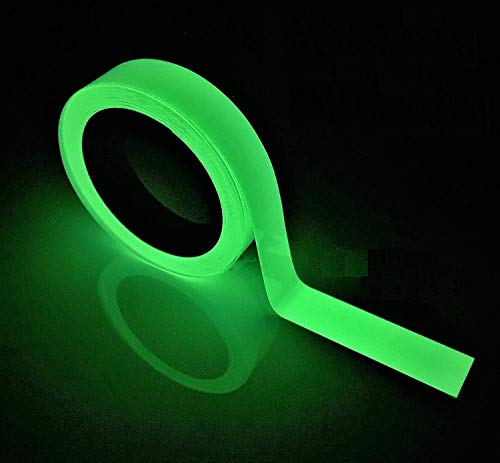
For step edges and the one root you can't move. The listing claims 30 minutes of light gives up to 6 to 8 hours of glow. It marks a trip hazard; it isn't a listed exit sign.
For the extinguisher on your fog and power setup, see fire and electrical, and for cord gauges and load math, power and extension cord safety.
Frequently Asked Questions
Do I need a permit for a haunted house in my garage? It depends on your city. Portland requires a fire marshal permit for “Haunted Houses, or similar temporary installations regardless of occupant load,” and its rule doesn’t mention private homes. We found no city or fire-district rule that exempts home haunts. Ask your fire marshal’s prevention office and get the answer in writing.
Does homeowners insurance cover guests at a home haunt? Liability and medical payments coverage are written for injuries to guests on your property, and NAIC says medical payments are paid “regardless of legal liability.” California’s insurance department says business activities are excluded from medical payments, and NAIC warns that an undisclosed home business can lead to cancellation. A ticketed haunt may count as one. Ask your insurer in writing.
Can visitors deduct donations to a home haunt? Not when they drop cash in a jar you hold. IRS Publication 526 says a contribution to a specific individual isn’t deductible. Have guests give directly to the charity, and check it at IRS.gov/TEOS.
What fire extinguisher does a haunted house need? Portland, Sacramento Metro and Livermore-Pleasanton all set 2-A:10-B:C as the minimum. Portland also wants one within 50 feet of every point, near each exit, with a service tag from the last year unless it’s new.
Related Resources
Start with yard haunt basics for the path, scare zones and power, and Halloween decorations vs. the neighbors for HOA, noise, light and sidewalk rules. The Yard Haunt Setup Countdown puts the permit and insurer calls on a timeline, and Yard Haunt Warning Signs covers the intensity signs at your entrance. For the scares themselves, see the Art of the Jump Scare.