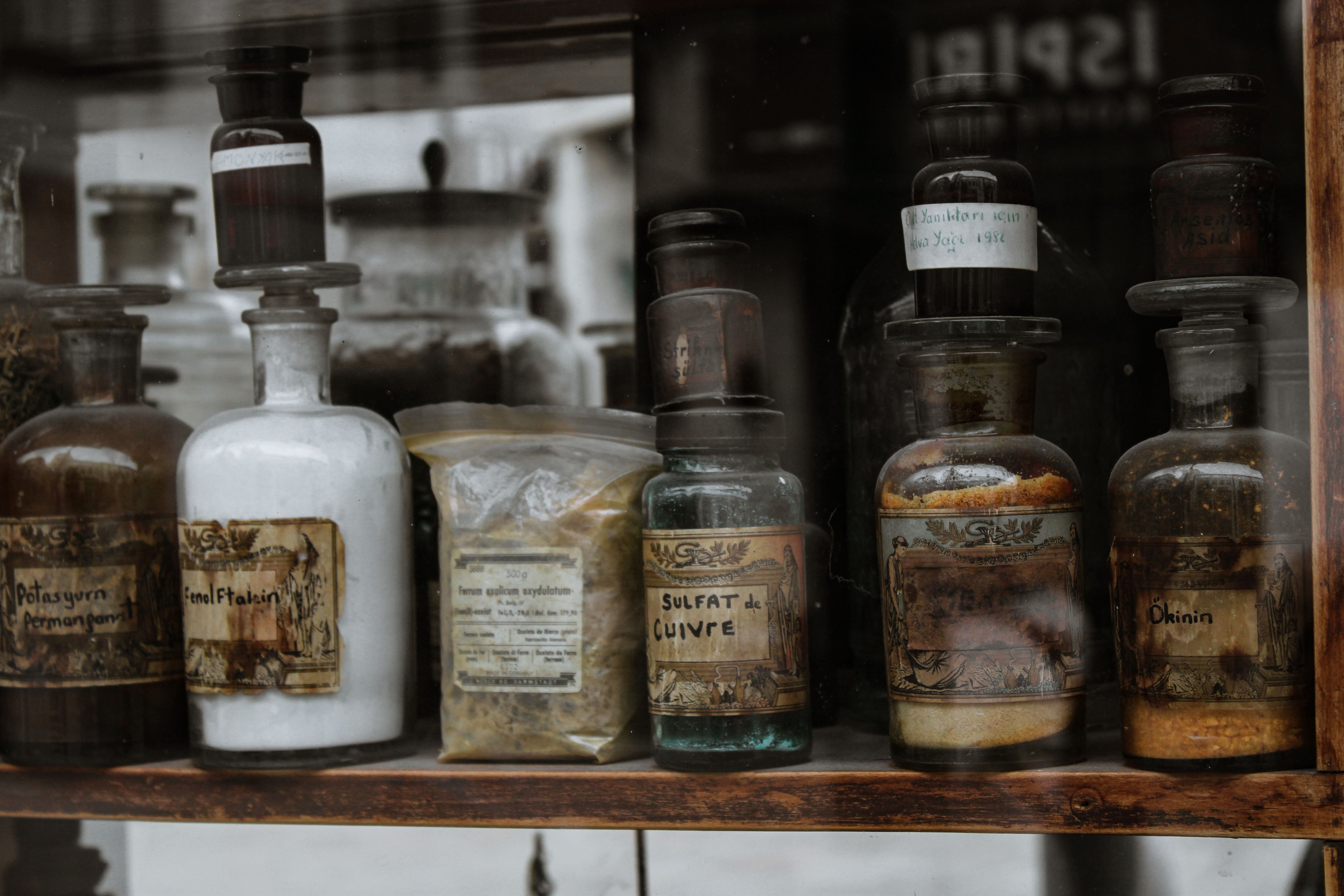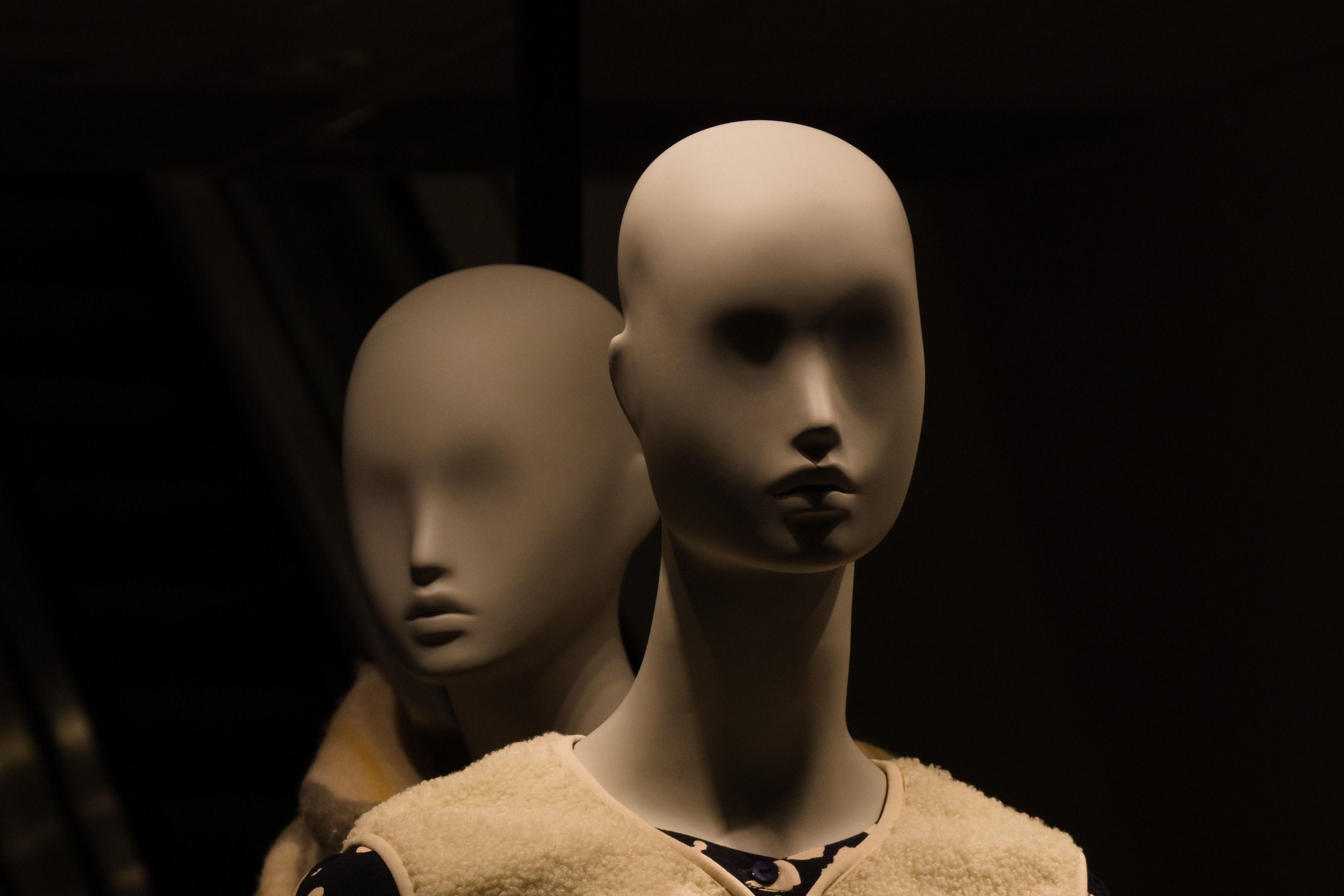
A dressed figure reads as a person because of its clothes, its posture and where it stands, not because of its face. That’s good news, because the cheap parts of the job (thrifted clothes, stuffing, dye, a hood) do most of the work, and the expensive part (a realistic head) matters least.
If your figures are outdoor witches around a cauldron, our witch coven yard scene covers frames, cloaks and weatherproofing for that build.
Pick the Body
There are four common starting points, and they differ most in two things you can’t change later: whether the figure can be posed, and where it can safely stand.
| Body | Pose | What it comes with | Where it works |
|---|---|---|---|
| Store fiberglass mannequin | Fixed when you buy it | Head, arms, legs, glass base | Indoors, on a floor |
| Budget plastic mannequin | Limited, per the listing | Head, arms, legs, metal base | Indoors, on a floor |
| Adjustable dress form | Torso only | Torso on a stand | Indoors |
| Skeleton or PVC frame | Fully yours | Whatever you build | Indoors or staked outdoors |
Store mannequins: the pose is a catalog choice
A retail fiberglass mannequin doesn’t bend. Mondo Mannequins sells its figures by pose, “Pose 1” through “Pose 4” in its City Female line, so the posture is something you pick from a catalog, not something you set in the living room (Mondo, City Female).
Mondo’s Slate Male is a useful reference for what a real one is like: “This 42-lb fiberglass mannequin ships with a 16-inch, round, tempered glass base, calf fittings, and a setup kit.” Its wrist fittings are “Push Pull,” so the hands come off for sleeves, and it has “an oval, featureless head” with fingers and feet that are “realistically detailed.” It cost $526.00 when we checked (Mondo, Slate Male).
That glass base is the reason a store mannequin belongs indoors. A 16-inch tempered glass disc is made for a shop floor. On a lawn it sits unevenly, and on a porch it’s a trip and breakage risk in the dark. That’s our reading of the spec; we didn’t see an outdoor rating on Mondo’s page.
Budget plastic mannequins
Amazon’s full-body mannequins are lighter plastic figures on metal bases, mostly from Amazon-only brands, so all we can report is what the listings claim. The one below claims polypropylene, a 73-inch height and that its “head, arms and legs are adjustable,” with a head that turns 360 degrees. The same listing gives its weight as 17 pounds in the bullets and 25 pounds in the product overview, so it disagrees with itself. Look at the listing photos for how the limbs join before you count on a particular pose.

FDW Male Full Body Mannequin, 73 Inch
A polypropylene full-body male mannequin on a metal base, from an Amazon-only brand. The listing claims the head turns 360 degrees and the arms and legs adjust, and lists the weight as both 17 and 25 pounds. It's an indoor figure: plastic on a flat metal base, made for a floor.
Dress forms
A dress form is a torso on a pole. It has no head, arms or legs, and you add all three. The advantage is that it adjusts, and its cover takes pins, so clothes can be pinned in place instead of taped.
Dritz’s Sew You form has “9 easy-turn wheels at the bust, waist, and hips” that adjust in half-inch steps, plus “2 auto-set dials” and a neck dial. Dritz says the Small-Medium size “Fits approximately US women’s sizes 4-12,” with a 33 to 40 inch bust, 26 to 33 inch waist and 35 to 42 inch hips, and the pole extends to 62.5 inches. Dritz describes the cover as “Foam-backed polyester fabric makes pinning and marking simple” (Dritz, Sew You). Dritz also makes a male form, the Mr. Tailor, and its pricier My Double Designer rolls on a “Five-legged caster base” with “lockable wheels” (Dritz, My Double Designer). If your form rolls, lock it before you dress it. A figure that drifts when a guest brushes past is no longer scary.

Dritz Sew You Adjustable Dress Form, Small/Medium
Dritz's entry form: wheels and dials at bust, waist and hips in half-inch steps, a pinnable foam-backed cover and a pole that reaches 62.5 inches, per Dritz. It fits roughly women's sizes 4 to 12, so thrifted clothes in real sizes go on with less padding. Add a head, arms and gloves.
Skeletons and PVC frames
If you need a pose a mannequin can’t hold (seated, hunched, reaching), build it. A poseable skeleton under clothes is the quickest route, and our skeleton posing guide covers locking the joints so the pose stays. For an outdoor figure, a PVC frame on a stake is the usual body; the PVC frames and armatures masterclass covers pipe sizes, sun and staking, and the coven guide’s building your own witches list covers pool-noodle arms and tomato-cage torsos.
Sizing and Padding the Body
Display bodies are small. Mondo lists its City Female at 33 inches at the chest, 24 at the waist and 35 at the hips, and its Slate Male at 38, 30 and 37. Most thrift-store clothes are cut for bigger people, so a jacket from the rack will hang off a store mannequin’s shoulders and collapse at the waist.
Padding the figure out is normal practice, not a workaround. The V&A describes the mannequin as “the foundation onto which bespoke body padding and underpinnings can be applied,” and says “selecting the right mannequin is crucial to the presentation of a garment” (V&A). For its Stormtrooper display, the museum secured the armor “onto the well-padded black jersey-covered figure,” and the arm pieces were “first individually mounted onto fabric covered Fosshape™ supports and then secured onto the mannequin” (V&A).
Our method for a home figure:
- Wrap the torso in batting where the clothes need it: shoulders, belly, hips. Hold it with packing tape or a few loose stitches.
- Pull a snug T-shirt over the padding. It keeps the batting in place and gives the outer clothes something smooth to slide over.
- Stuff the gaps. A pillowcase of fiberfill makes a paunch; a handful at each shoulder squares off a coat.
- Fill the sleeves and legs on a dress form or frame with pool noodles or rolled batting, so they hang like there’s an arm inside.
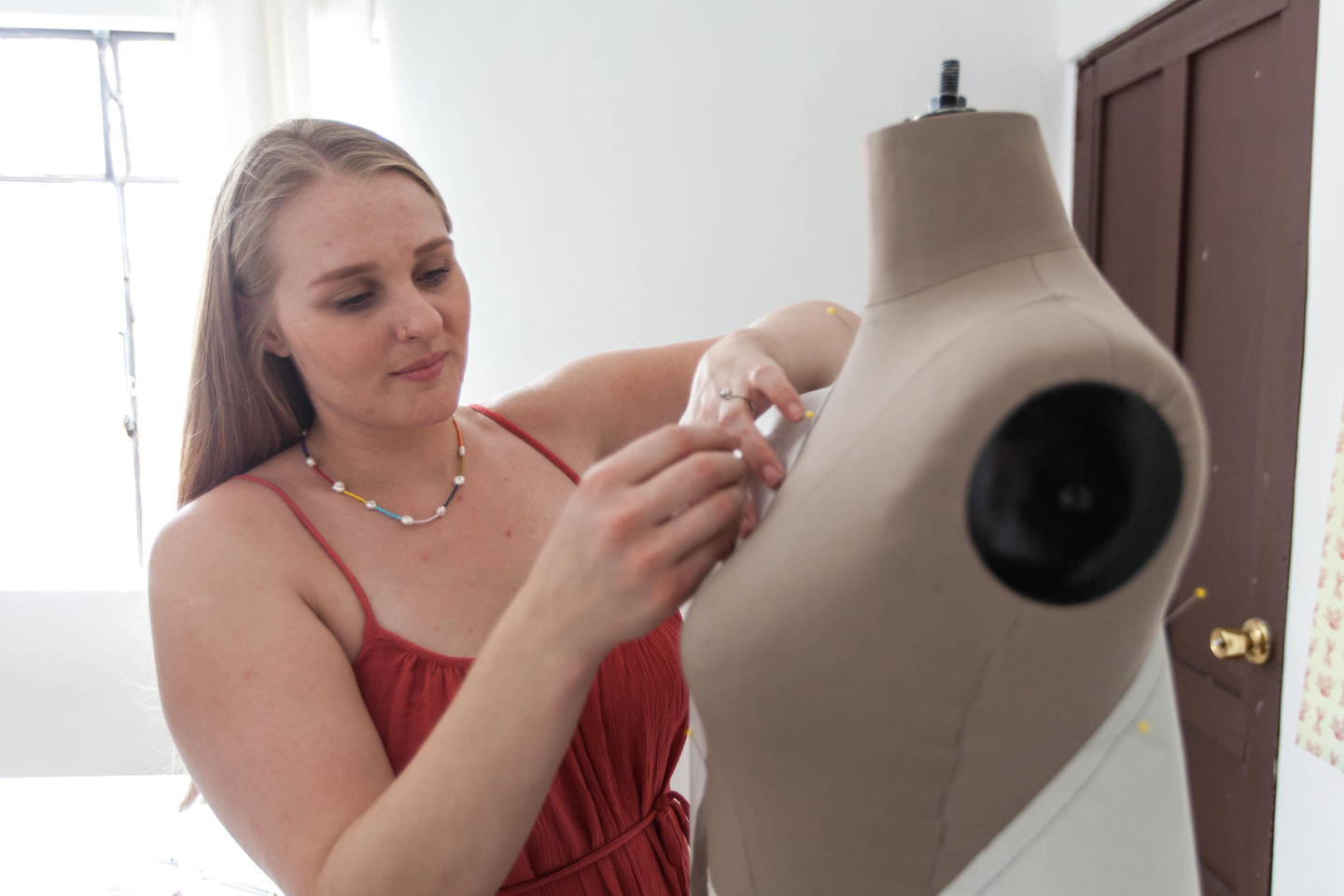
Fairfield, which makes Poly-Fil, says “We recommend spot cleaning your project to avoid shifting or bunching of the fiberfill” (Fairfield FAQ). For a figure, that means padding you can pull out and air dry beats padding sewn into the clothes.
Don’t leave heavy clothes hanging from the shoulders all season. The V&A warns that leaving a dress “on a hanger for long periods” can “cause stress on the seams and shape” (V&A), and a mannequin’s shoulders are a hanger. Padding spreads the weight.

Poly-Fil Fairfield Original Fiber Fill, 32 oz
Polyester stuffing for bellies, shoulders and hollow sleeves. Fairfield says it doesn't chemically treat its products to prohibit burning, so keep a stuffed figure away from any heat or flame.
Heads and Faces
A realistic face is optional. Mondo sells its Slate with “an oval, featureless head,” and the V&A built its Africa Fashion figures around “a new female head” that “could fit on multiple bodies.” From the end of a hallway or the sidewalk, a blank head under a hood, hat or veil reads as a person, and the viewer fills in the face. Our haunted hallway guide makes the same point about the figure at the end of the hall.
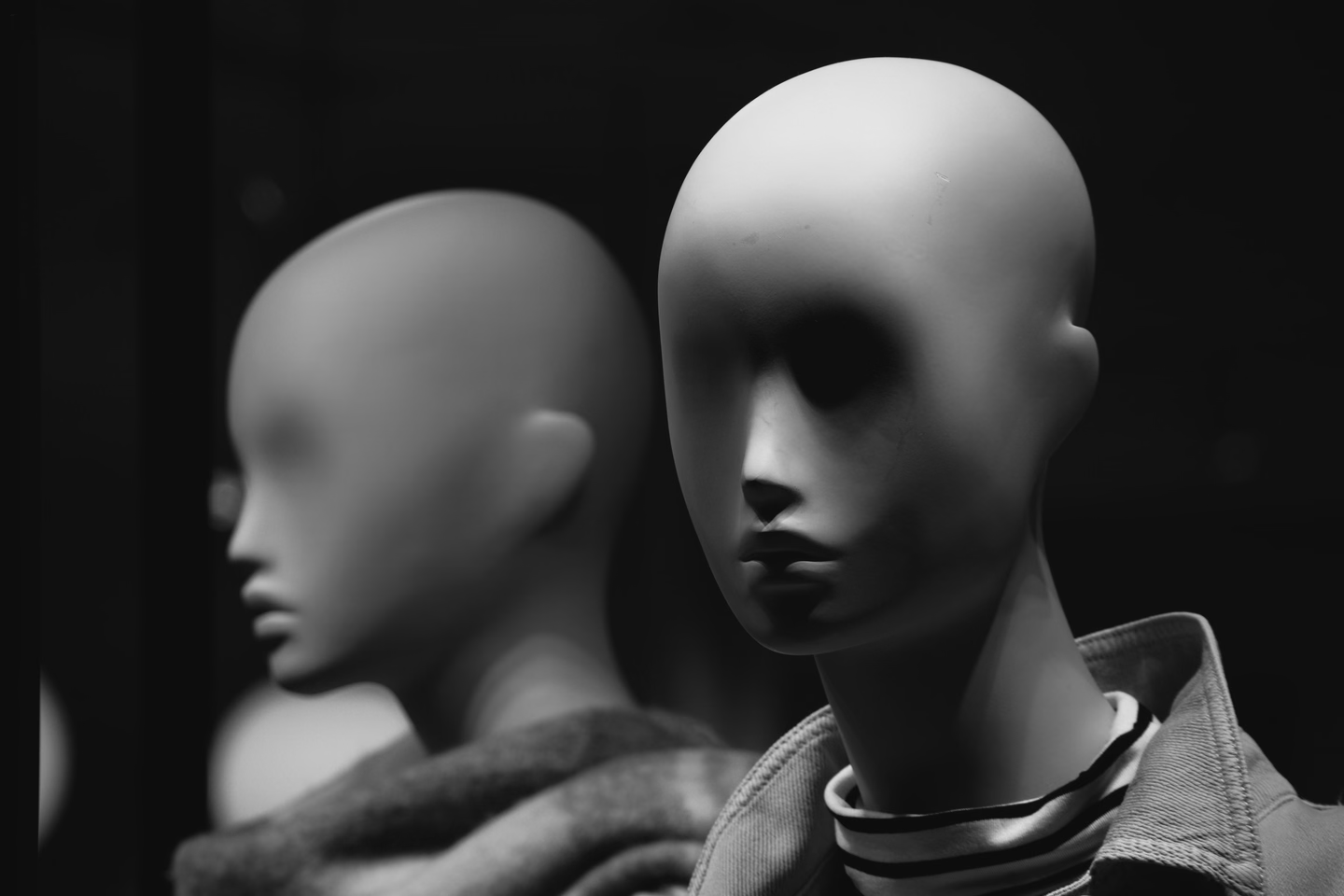
Foam wig heads are the cheap way to give a dress form or frame a head. Our method: push a dowel or a length of PVC up through the clamp hole in the base, glue it, and fix the other end to the figure’s neck. Pin a wig or hood to the foam with T-pins. For color, use water-based craft paint on the foam, and cover it with a hood or hat anyway, because bare white foam glows under any light.
Masks turn a head into a character. Many full-head masks are latex; check the listing, and if it is, anyone with a latex allergy should leave the handling to someone else. MedlinePlus explains why: “If your immune system detects the protein, a reaction can start in minutes,” and “in rare cases you could have a severe reaction called anaphylaxis” (MedlinePlus). A mask needs something inside it to hold its shape, so stuff it with crumpled paper or fiberfill around a foam head. We didn’t find a generic realistic mask with reviews good enough to recommend, so shop by the listing photos and reviews.

Leeven Styrofoam Wig Head, Female
A white foam head from an Amazon-only brand with a clamp hole in the base, which is where a dowel or pipe goes in to mount it on a figure. The listing gives its height as 11.6 inches in the bullets and 11.4 inches in the description; either way it's about life size.
Hands and Feet
Hands give a figure away faster than faces, because they’re usually lit and usually at eye level with a guest’s hands. Mondo gives the Slate “realistically detailed” fingers with “Push Pull” wrists, so the hands come off to feed sleeves on. On a dress form or frame, you have three choices: stuffed gloves, prop hands, or no hands at all (sleeves pinned into pockets, arms folded under a cloak).
Our method for gloves: stuff them with batting and push a short dowel or a bent wire into each finger for the pose. Leather work gloves look more like skin than knit ones do. For prop hands, check what they’re made of. The pair below is vinyl, which means no latex worry.
Feet matter on store mannequins more than you’d expect. Mondo lists the City Female’s heel height as 4 inches, which means the foot is sculpted to stand in a four-inch heel, and a flat boot won’t sit right. The Slate Male’s is 1 inch. Match the shoes to the sculpt, or hide the feet under a long coat or skirt. On a frame, a pair of old boots with a cardboard tube or PVC stub in each one gives legs something to stand in.

Medou Realistic Prop Hands, Left and Right
A left and right hand in skin-colored vinyl, about 7.8 inches long, from an Amazon-only brand. They're sold as severed hands, so sleeve cuffs hide the cut ends. Vinyl rather than latex, per the listing.
Aging the Clothes
New clothes on a figure look like a store window. Aging them is what turns a mannequin into someone who has been standing in that corner for years.
Read the label before you pick a dye
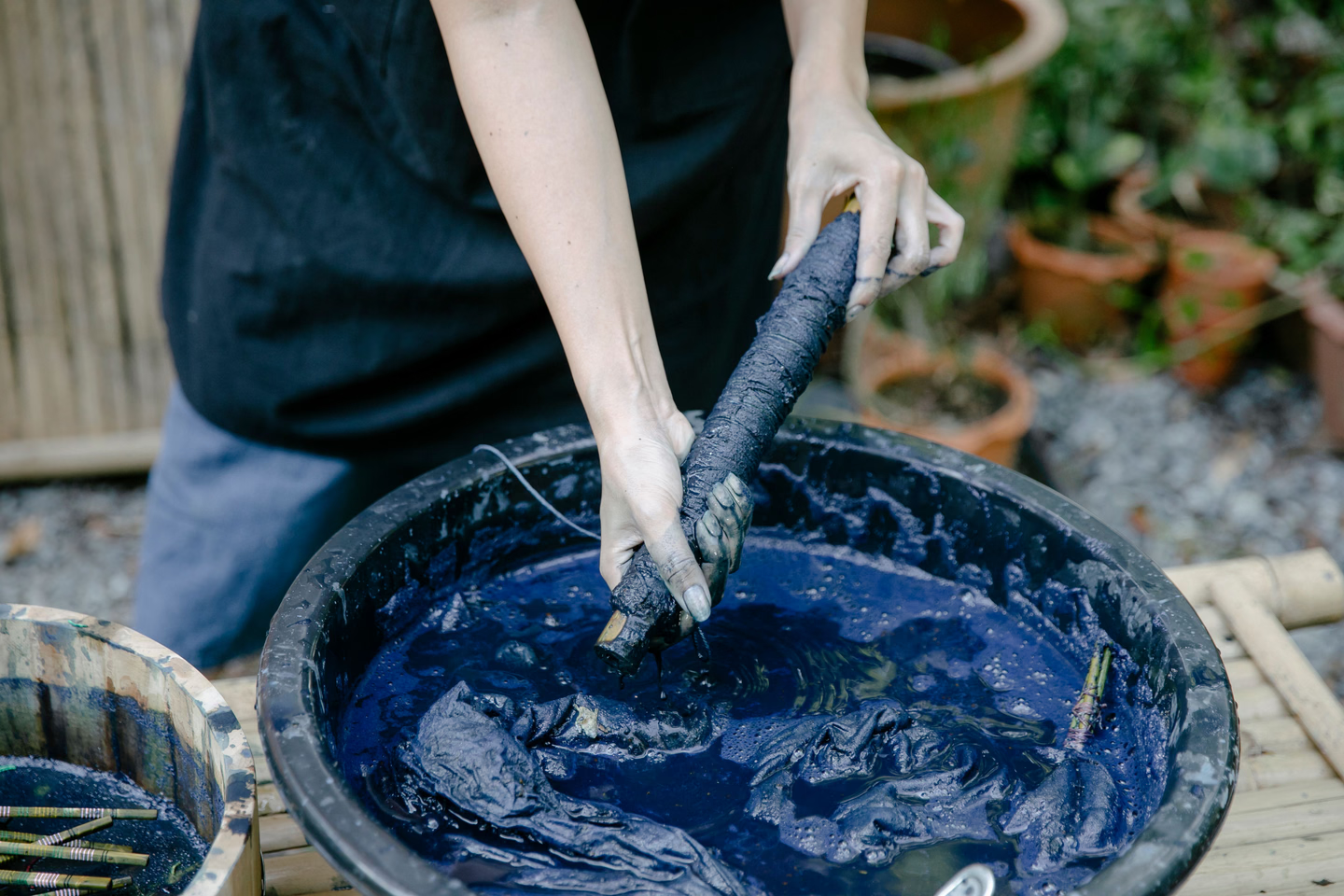
Rit makes two different dyes, and fiber content decides which one works. Rit says its All-Purpose Dye “is for natural fabrics, such as cotton, linen, wool, silk and ramie. It also dyes rayon and nylon. If the garment you want to dye contains more than 35% synthetic material (such as polyester, acrylic or acetate), then you must use Rit DyeMore Synthetic Fiber Dye instead” (Rit, All-Purpose). Check the tag first. Thrifted clothes are often blends, and a lot of costume fabric is polyester.
Cotton, linen and blends under 35% synthetic: All-Purpose. Rit’s sink or bucket method calls for 3 gallons of water per pound of fabric, water at about 140°F, and one liquid bottle or two powder packages for every 2 pounds of dry fabric. To enhance the color, Rit says to “add 1 cup of salt when dyeing fabrics containing cotton, rayon, ramie or linen” or “add 1 cup of vinegar when dyeing fabrics containing nylon, silk or wool.” The item “can remain in dyebath from 10 minutes up to one hour,” and “Fabric will look darker when wet and will dry lighter.”
Polyester and synthetics: DyeMore, on the stove. Rit says “you must use the stovetop method to maintain an almost boiling temperature for the duration of your dyeing,” 200°F or more, which means “you cannot dye anything that won’t fit into a pot on your stove” and you can’t use a washer. It adds that on a colored synthetic, “your only option is to overdye it with a darker color” (Rit, DyeMore). Rit’s own pages disagree slightly on temperature: its FAQ gives 140° to 160°F for All-Purpose and 180° to 220°F for DyeMore (Rit FAQ), while the instruction pages say 140°F and 200°F or greater. Follow the instruction page for the product you’re using.
Use a pot you don’t cook in. Rit says “Rit is not a food-grade dye so we do not suggest using a container that is also used for food,” and if you must reuse one, to clean it “with chlorine bleach or a powdered cleanser after dyeing” (Rit FAQ).
Fixative. Rit says its ColorStay Dye Fixative “reduces bleeding, fading and even enhances the color,” and that “It works on cotton, linen, silk, wool, ramie and rayon.” Use it “immediately after dyeing, before rinsing and laundering” (Rit, ColorStay). Rit’s DyeMore page only calls for it on a blend “containing cotton, linen, rayon or ramie,” so skip it on straight polyester. The ColorStay bottle on Amazon lists “Cotton, Wool, and Nylon” as compatible materials, which isn’t Rit’s list; go by Rit’s.
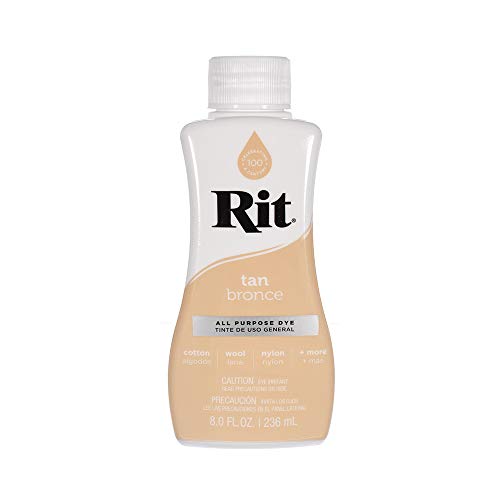
Rit All-Purpose Liquid Dye, Tan, 8 oz
Tan is the grime color: a light dip dulls white shirts and bright cotton to old-cloth beige. All-Purpose is for cotton, linen, wool, silk, ramie, rayon and nylon; over 35% synthetic, Rit says to switch to DyeMore.

Rit DyeMore Synthetic Dye, Graphite, with Color Fixative
Dark gray dye for polyester, acrylic and acetate, the fibers Rit sends to DyeMore rather than All-Purpose. Rit says it has to be held at about 200°F on the stove, not in a washer, whatever the listing says about washing machines. The bundled fixative only helps on cotton, linen, rayon or ramie blends.
Tea, coffee, sanding and dirt
We didn’t find a maker or museum method for these, so this is ours.
- Tea or coffee. Brew it strong, soak natural-fiber clothes until they’re a shade darker than you want (they dry lighter), and wring them out unevenly so some areas stay darker. Dunk hems and cuffs a second time. Stick to cotton and linen: tea and coffee are plant stains, and we wouldn’t count on them taking on polyester.
- Wear where wear happens. Sand or rasp the elbows, knees, cuffs, collar and pocket edges, the places real clothes thin out. A wire brush or a cheese grater frays a hem faster than scissors and looks less cut.
- Dirt from the ground up. Rub garden soil or a dry brown pastel into the lower legs and hem, heaviest at the bottom. Shake off the loose grit so it doesn’t shed on the floor.
- Fade the shoulders. Real clothes fade on top where the light hits. A light mist of diluted bleach on dark cotton shoulders lightens them. Rinse well, and do it outdoors. Bleach goes last: Rit warns that sun and bleach damage fabric, “making it very difficult to dye,” so dye first.
The V&A’s advice for storing a good dress runs the other way. It wants a “pH neutral medium (containing no acid or alkali, which causes yellowing/discolouration).” That yellowing is the look you’re after on a prop, not on anything you want to keep.

Painting Plastic Parts
Store mannequins, prop hands and skeletons often need a new color, from a corpse gray to a grimy skin tone. Krylon’s Fusion All-In-One is the spray-paint maker’s plastic answer. Krylon’s product details list it for “Metal, Wood, Plastic, Laminate, Masonry, Concrete, Wicker, Glass, Plaster” (the description above them adds PVC). Krylon also says “No sanding or priming needed,” and gives “Best results when temperatures are 55° F to 75°F and humidity is below 60%” (Krylon).
Two cautions. Krylon’s page doesn’t name polypropylene, and a search of Krylon’s site for it returns nothing. That matters because budget mannequins and some skeletons are polypropylene (Spirit lists its Pose ‘N’ Stay as “85% PP,” as our corpsing masterclass notes). Spray a hidden spot first and scratch it once it’s dry before you paint a whole figure. Second, Krylon’s safety data sheet for Fusion Matte Black says “Use only outdoors or in a well-ventilated area” and “Do not spray on an open flame or other ignition source” (Krylon SDS), so paint in the driveway, not the garage.
The Amazon listing gives slower dry times (“dry to the touch in 25 minutes, dry to handle in 2 hours”) than Krylon’s page (“20 minute” to touch, “1 hour” to handle). Give it the longer one before you dress the figure.
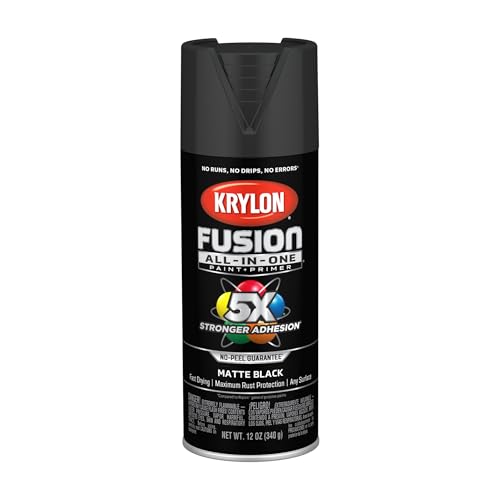
Krylon Fusion All-In-One Spray Paint, Matte Black, 12 oz
Krylon's no-primer spray for plastic, wood and metal. Paint between 55 and 75°F under 60% humidity, outdoors or with plenty of air. Krylon doesn't list polypropylene, so test a hidden spot on a PP mannequin or skeleton first.
Blood on Clothes
On a costume you’ll wear again, fake blood staining is the risk. On a figure’s thrifted shirt, it’s the goal. Mehron’s own label says “Product may stain. Pre-testing is recommended,” and Kryolan says “high-quality cosmetic ingredients are not automatically easy to remove from clothes”; our makeup and fake blood guide has the details on each brand. For a figure, that means stage blood like Mehron’s will set into the fabric.
Two things change when the bloody figure lives outside or in a warm room:
- Syrup and insects. Graftobian claims its water-based blood “will not attract flies,” unlike sugar-syrup blood. We read that as a reason to keep syrup blood indoors and short-term.
- Rain moves it. Wet blood on an outdoor figure can run pink onto a porch or path. That’s our inference, not a maker’s claim; stage a bloody figure under cover, or let the blood dry fully before it goes out.
Skip any homemade recipe that calls for Kodak Photo-Flo. The maker’s safety data sheet says “Do not taste or swallow. Avoid contact with skin and clothing,” as the makeup guide explains.
Posing, Weight and Wind
Indoors, a figure’s biggest risk is a guest bumping it in the dark. Weight the base low or strap the figure to the wall; our weighting and anchoring props indoors guide covers both, and how to keep a base from marking the floor. Lock caster wheels on a dress form.
Outdoors, stake a frame rather than standing a mannequin on its base. Fix hats and hoods to the head through the fabric with UV-rated zip ties or wire, and weight or pin the hems so a coat can’t sail. The wind section of our skeleton guide has the National Weather Service’s wind descriptions, and a figure in a long coat catches more than a bare skeleton.
Posture sells the figure. A slight head tilt, one shoulder lower than the other, weight on one leg, hands doing something (holding a lantern, resting on a railing). Two identical upright figures side by side look like a shop window.
Lighting a Figure
Every light near a dressed figure should be an LED. Clothes, wigs, fiberfill and hoods all burn. NFPA’s Halloween tip sheet says to “Keep all decorations away from open flames and other heat sources like light bulbs and heaters” (NFPA), and ENERGY STAR says “incandescent bulbs release 90% of their energy as heat” (ENERGY STAR).
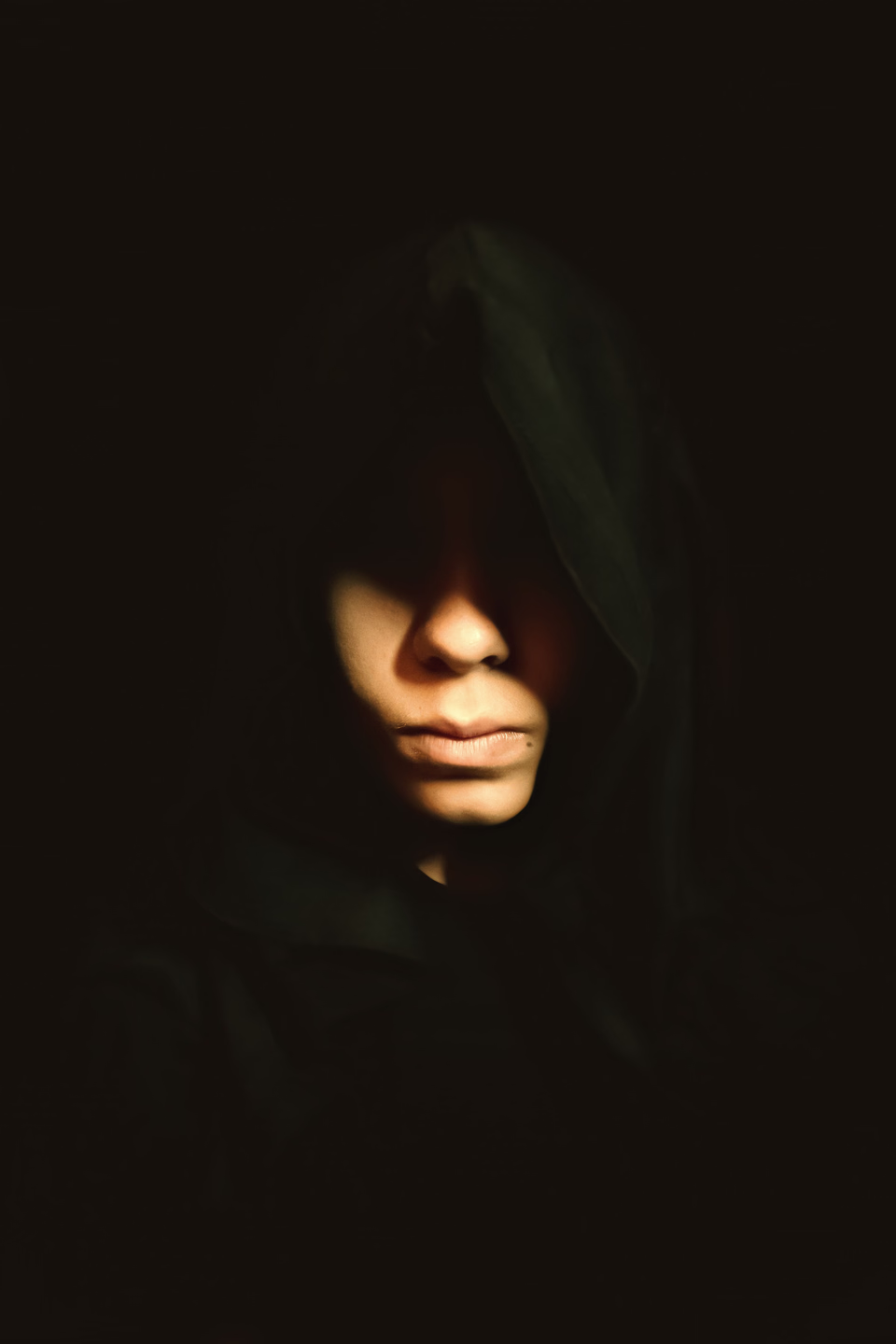
Placement is where a mannequin stops looking like one. Our approach:
- Light from the side or below, never straight on. A flat front light shows every seam and the plastic sheen. Side light puts half the figure in shadow, and uplight from the floor makes any face unnatural in a way that reads as intentional.
- Backlight the silhouette. A dim light behind the figure outlines the shoulders and head, which is all the eye needs to read “person.”
- Keep the eyes dark. A hood, a hat brim or a low angle that leaves the eye sockets in shadow hides the least convincing part of any head.
Our indoor lighting masterclass covers fixtures and angles in more detail.
Outside in October
A dressed figure outdoors is mostly fabric, and a month of weather works on it the same way it does on the coven’s cloaks.
- Sun fades it. The Library of Congress says “dim light over a long period of time is just as damaging as bright light over a short period of time” (Library of Congress). Turn the figure or swap its outer layer halfway through the month.
- Rain soaks the padding. Bring figures in before storms, and if the padding gets soaked, pull it out to dry rather than leaving it inside wet clothes. A water repellent like 303 Fabric Guard helps the outer layer shed a shower; the coven guide’s weatherproofing section has Gold Eagle’s cure times and limits.
- Fire rules still apply. Fairfield says “100% polyester products are flame retardant by nature because they will not burn unless they are in direct contact with a flame,” and that it “does not chemically treat its products to prohibit burning” (Fairfield FAQ). CPSC’s version is blunter: “any fabric can burn if it comes in contact with an open flame” (CPSC). Keep candles, luminaries and hot bulbs away from every figure. Retardant sprays wash out in rain, as our fake fire guide explains.
Don’t Stage a Real Emergency
A realistic figure is the goal indoors and in a walkthrough. Out front, it can be too realistic. This is our opinion: nothing that looks like a real person in trouble, such as a body in the street, someone slumped in a parked car or a figure lying near the curb. A driver at night can’t tell, and the 911 call or the swerve is on you. Our neighbors guide covers this in How Far Is Too Far?
We also don’t hang human figures by the neck, anywhere. A noose on a human figure carries the history of lynching, and a neighbor shouldn’t have to find out from the sidewalk whether it’s a decoration.
Frequently Asked Questions
Can I pose a store mannequin? Not a fiberglass one. The pose is sculpted in, and makers like Mondo sell different poses as different models. Choose the pose when you shop, or use a skeleton or a frame for anything seated or bent.
Why don’t thrift-store clothes fit my mannequin? Display bodies are small: Mondo’s City Female is 33, 24 and 35 inches at bust, waist and hips. Pad the body out with batting and fiberfill under a snug T-shirt, the way museums pad their mounts.
Which Rit dye do I need for a polyester costume? DyeMore. Rit says anything over 35% synthetic needs DyeMore, held near boiling on the stove, which also means it has to fit in a pot.
Can a mannequin stay outside? A store mannequin on a glass base belongs indoors. For outdoors, dress a staked frame or a skeleton, fix the clothes against wind, and bring it in before storms.
Does the figure need a realistic face? No. A featureless head under a hood reads as a person from a distance, and it’s less likely to look fake up close than a cheap realistic mask.
Related Resources
For a figure in a hallway or doorway, see creating a haunted hallway and the jump scare masterclass. A figure that moves on its own is covered in the animatronic repair and hacks guide, and a dried-corpse look for a skeleton in corpsing a skeleton. Browse the best Halloween props for figures you can buy ready-made.